
Decarbonisation is no longer a specialist initiative. It’s how the business runs.
For years, decarbonisation sat slightly apart from “core” business decisions – a specialist initiative, a reporting requirement or a future ambition. That line is now blurring fast.
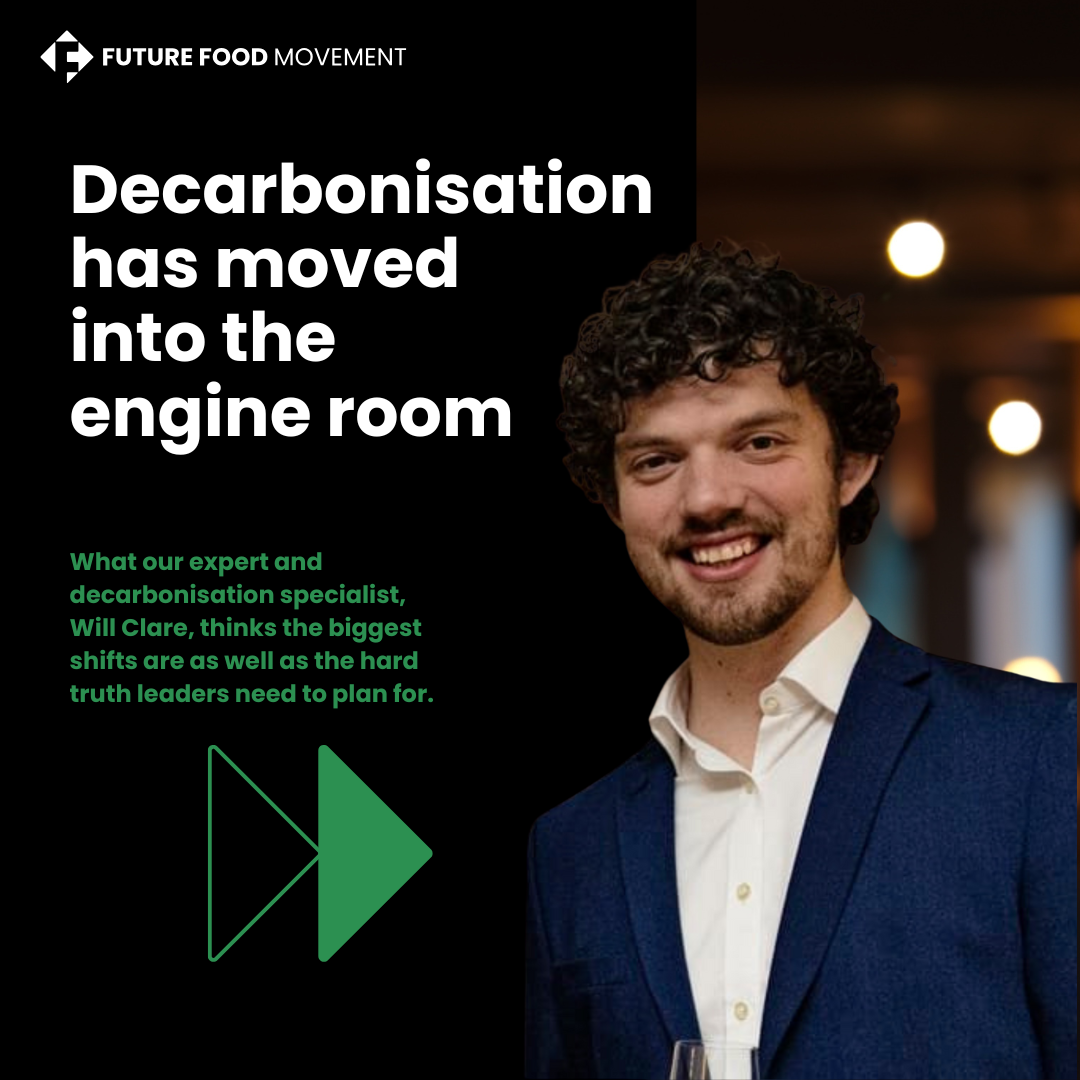
What we’re seeing across the food system is a more pragmatic shift. Net zero is increasingly treated as a commercial reality that shapes sourcing, investment and risk management. As Will Clare, Future Food Movement’s decarbonisation specialist, puts it, "the conversation has moved from whether to act, to how action fits into everyday decision-making."
This shift hasn’t been linear. Policy uncertainty and evolving frameworks have slowed some initiatives. But in parallel, businesses have gained sharper clarity on where action really needs to happen, and where it doesn’t.
From reporting to action, and from silos to supply chains
One of the most important developments has been a clearer separation between reporting and real-world change. Leaders now understand that reducing Scope 3 emissions isn’t a modelling exercise, it’s a relationship challenge.
Early efforts were often retailer-led and top-down. Now, momentum is moving upstream. Farm-level data is increasingly recognised as essential, not optional, for credible decarbonisation and long-term carbon removal strategies. That shift is unlocking collaboration across value chains, rather than pushing responsibility in one direction.
Data is still the bottleneck
Progress slows where data stays generic, however. Food businesses are grappling with complex product footprints and the limits of average emission factors that no longer reflect reality. As organisations dig deeper, the need for more specific, product-level data becomes unavoidable – driven by competition, customer demands and the need to hit real targets.
The encouraging signal? More businesses are now building bottom-up footprints and sharing that data across suppliers and customers. That’s how clarity and confidence start to form.
Two things stand out
First, collaboration is becoming the norm rather than the exception. Second, sustainability leaders increasingly sit at senior tables, linking climate action directly to resilience and long-term performance. That visibility matters.
The hard truth leaders need to plan for
Budgets are tight. ESG funding isn’t guaranteed. Progress will depend on integrating climate action into “normal” projects and decisions, not waiting for perfect conditions.
Decarbonisation across Scopes 1, 2 and 3 is complex, long-term and sometimes slow. But it’s also unavoidable.
Future Food Movement helps organisations turn decarbonisation ambition into credible delivery. Through Leadership Days, product-level foot printing, realisable decarbonisation pathways, organisational inventories and ongoing technical advisory, led by specialists like Will Clare, we support teams tackling Scope 3 strategy, supplier engagement and practical pathways to 2030 and beyond.
"If your business is ready to move decarbonisation from intention into execution, we’d love to work with you."
Will Clare, Decarbonisation Lead.
Our next Drop-in Technical Clinic for Silver + members is a space where our members can bring live sustainability challenges and get direct input from our technical experts. It’s not a webinar. It’s a problem-solving room for doers.
Our first session, on 12th February 2026, focuses on decarbonisation: from ambition to implementation.
If your business is hitting roadblocks on Scope 3, struggling to turn targets into action, or looking for smart ways to build resilience through climate performance - this is the kind of support we’re offering.
Want to join our next Drop-in Clinic or explore how we can support your team? Get in touch at hello@futurefoodmovement.com