
From soil to supermarket: the real barrier to scaling regenerative agriculture
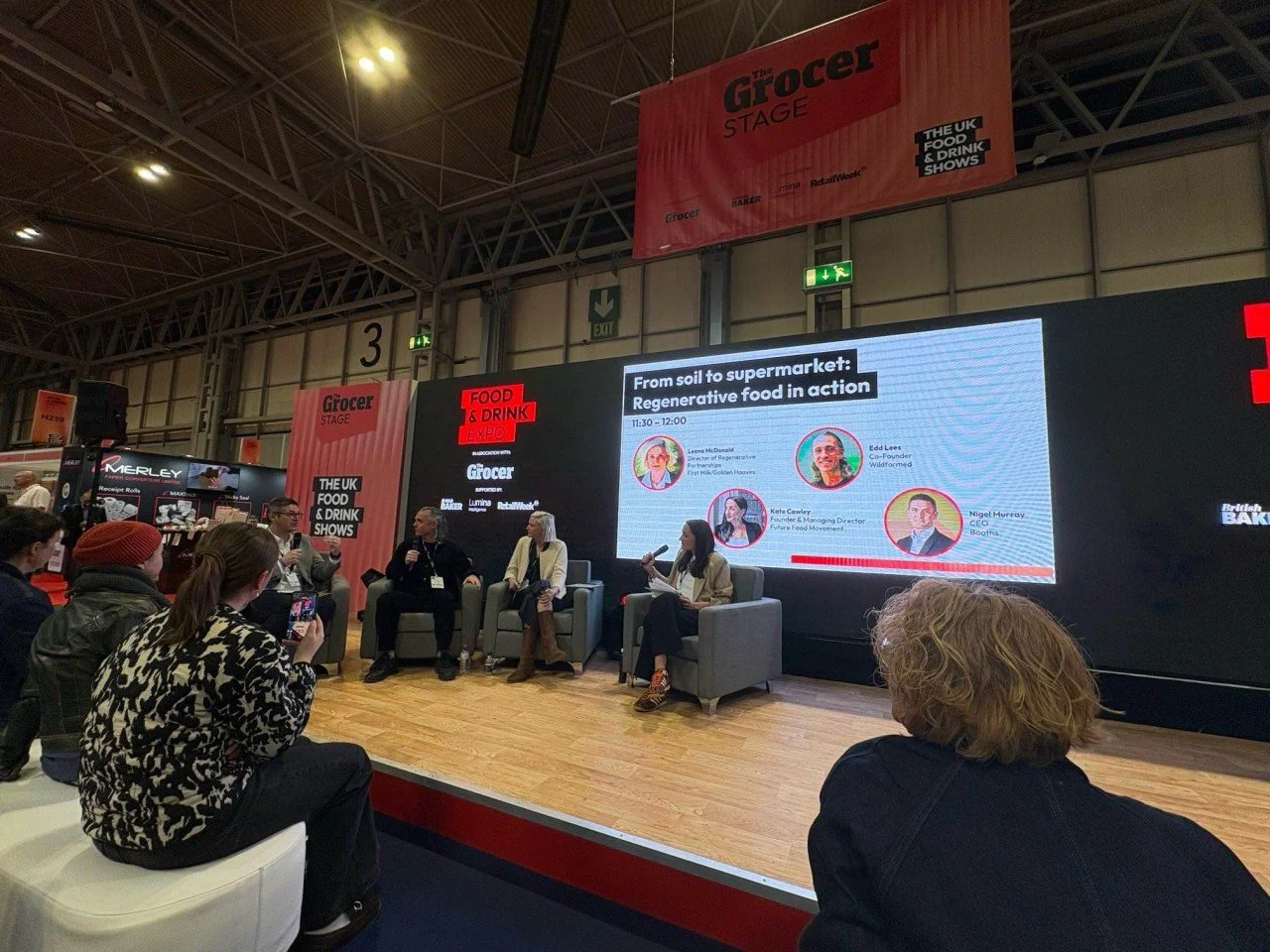
Future Food Movement chaired a standout discussion on The Grocer Stage at the Food & Drink Expo, bringing together Nigel Murray of Booths, Leona McDonald of First Milk and Edd Lees of Wildfarmed to explore a question rising fast up board agendas:
What will it actually take to scale regenerative agriculture commercially?
The conversation was candid, practical and notably free of jargon.
The clearest takeaway was this:
Regenerative agriculture is no longer being held back by farmer intent. It is being held back by market design.
Farmers are already adapting. New models are emerging and innovation is happening across supply chains.
But many businesses still buy, price and measure performance through systems built for short-term efficiency rather than long-term resilience. That creates a growing disconnect.
Companies say they want secure supply, lower risk, stronger provenance and progress on sustainability. Yet commercial models often still reward lowest upfront cost, quarterly savings and interchangeable commodity thinking.
As Leona McDonald put it, regenerative agriculture will not scale unless risk, reward and accountability are shared more evenly across the supply chain.
That matters because transition costs currently sit disproportionately with those least able to absorb them, while much of the long-term value lands elsewhere.
Kate Cawley reflected after the session that one comment captured the issue perfectly: Farmers are ready. The question is whether the system is ready to move with them.
This reaches far beyond farming. Across the food sector, many of the biggest opportunities now depend on whether leadership teams can modernise the commercial conditions around them, not simply declare new ambitions.
That means rethinking:
procurement models that undervalue resilience
KPIs that prioritise short-term wins over strategic security
supplier relationships based on extraction rather than partnership
finance models that struggle to back long-horizon returns
measurement systems that miss quality, provenance and risk exposure.
Edd Lees brought this to life through grain markets...why do we treat products with very different quality, provenance and environmental value as if they are identical commodities?
In categories such as wine, coffee and cheese, provenance drives margin and loyalty. In staple ingredients, value is too often stripped out by the system before it reaches the shelf. That is not just an agricultural issue. It is a commercial one.
Another major theme was resilience. Resilience is directly linked to supply continuity, margin protection, input security and brand trust.
Soil health, biodiversity and farming capability are becoming strategic business variables.
What this means for leaders
The businesses best positioned for the next decade are unlikely to be those making the loudest claims.
They will be those redesigning incentives, supplier models and decision-making frameworks early enough to capture advantage.
At Future Food Movement, this is where many member conversations are now focused: how to turn sustainability ambition into commercial execution.
Because the next phase of competitive advantage may not come from having the best strategy on paper.
It may come from being the first to build a system that can actually deliver it.