
Regenerative agriculture won't scale without farmers at the table
Regenagri joins with Future Food Movement as a strategic partner to help businesses scale regenerative agriculture
At the Food & Drink Expo, Future Food Movement chaired a panel on The Grocer Stage with Nigel Murray of Booths, Leona McDonald of First Milk and Edd Lees of Wildfarmed. The question on the table: what will it take to scale regenerative agriculture commercially?
The clearest answer to come out of it was that farmer intent isn't the blocker anymore: market design is. Businesses still buy, price and measure performance through systems built for short-term efficiency, while asking for secure supply and long-term resilience. Leona McDonald put it directly: regenerative agriculture won't scale until risk, reward and accountability are shared more evenly across the supply chain. Kate Cawley's read afterwards was that farmers are ready, and the open question is whether the system is ready to move with them.
That's the gap Future Food Movement and Regenagri are now working on together, through Future Food Movement’s Farmer-Led Working Group.
The Working Group brings farmers and food industry leaders together before decisions are made, while businesses are still working out where risk sits and what evidence they need. Regenagri joins as a partner sharing what it's learning across certification, farm-level data and carbon insetting, and testing it against what farmers and FFM members are seeing on the ground.
Regenagri’s certification and traceability programme spans more than 330,000 farms across 30 countries. Through our partnership, the farm-level data sits in the same room as farmer insight and the commercial reality food businesses are working with – not as separate inputs, but as one conversation.
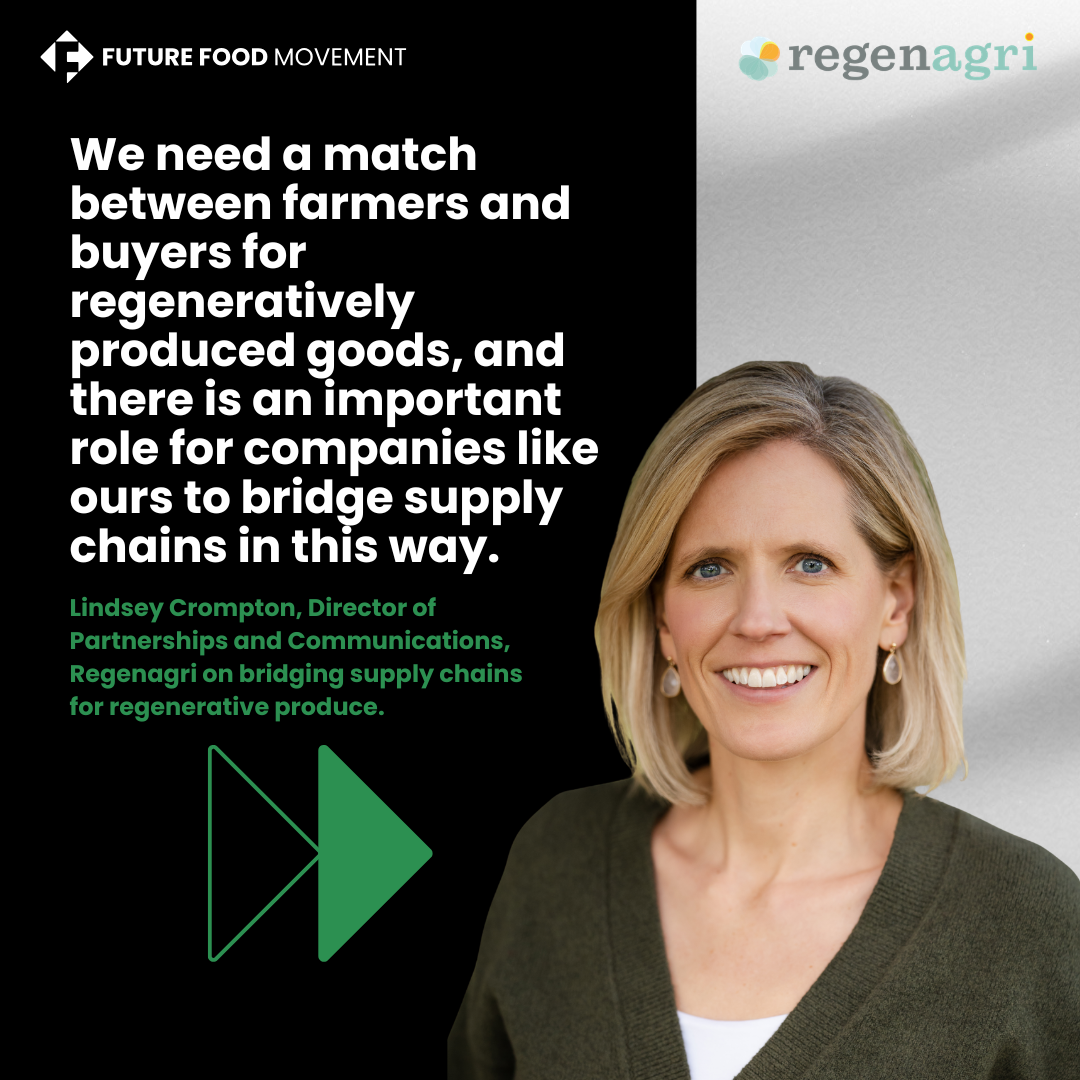
As Regenagri's Director of Partnerships and Communications Lindsey Crompton explained at Future Food Movement's May Members Expert Event:
"We need a match between farmers and buyers for regeneratively produced goods, and there is an important role for companies like ours to bridge supply chains in this way. This extends all the way through to supporting brands and retailers in communicating ‘regenerative’ to their consumers.”
Her advice for getting started is to avoid trying to cover everything at once: identify one high-impact supply chain, then map what a regenerative approach brings for risk, resilience, as well as environmental and social impact. Picking one clear priority and learning properly is key. Regenagri’s work with illycaffè, sold through Waitrose, and with Walmart on cotton, is what that looks like once a business commits.
"We're delighted to be part of Future Food Movement's network. We're here to listen and learn, but also to play an active role in helping the industry transition to a food system fit for the future. If you're exploring how regenerative agriculture can de-risk your business, we'd love to talk." Lindsey Crompton, Director of Partnerships and Communications, Regenagri
The next Farmer-Led Working Group session runs on 15th September. Places are limited and the room stays balanced between farmers and businesses, so if you want a seat, secure it now.
Not yet a member? The Farmer-Led Working Group is part of Future Food Movement corporate membership. Speak to our team about joining