
The freezer aisle is being reappraised. Children's food is the next test.
Meet our newest member: Wildly Tasty
Frozen has spent years carrying a reputation it didn't entirely earn. Lower price, lower quality, the thing you fall back on when the week gets away from you. That perception is shifting, but unevenly. In farm shops and garden centres, a frozen meal made with local, high-quality ingredients reads as a premium buy. In the supermarket, the same product sits alongside decades of price-led messaging, while the chilled aisle keeps the quality halo. The gap between those two shopper mindsets is one of the more interesting commercial problems in retail right now, and it's being closed by a growing group of challenger brands rather than by the category leaders.
Children's food is where that shift gets tested properly. There's no shortage of innovation aimed at babies and toddlers. Once a child is past that stage, the options narrow fast: adult formats made smaller, or convenience food built around a fairly short list of familiar ingredients. Somewhere between three and ten years old, a lot of families fall into a gap that nobody has really claimed, at exactly the age when eating habits are forming and vegetables and pulses are hardest to land.
Wildly Tasty, our newest member, is building in that gap. Founder Louisa Mitchell launched the business to get more children eating plants, and took the range through our Food Systems Essentials Accelerator in 2024. We asked her about the signals she's watching, what she's changed her mind about, and the trade-offs of scaling a small food business without loosening its sourcing standards.
Wildly Tasty is going up against some huge names in the frozen aisle. What's the signal you're watching most closely right now in the market?
The growing popularity of the frozen aisle is certainly an exciting signal, although there is still a long way to go. In farm shops and garden centres, shoppers often perceive frozen meals as a premium proposition, particularly when they feature locally sourced, high-quality ingredients. That perception doesn't always translate to the supermarket, where frozen food can still be associated with lower prices and lower-quality ingredients compared with the chilled aisle.
However, it's encouraging to see the growing number of challenger frozen meal brands entering retail, particularly over the past year, helping to elevate the category and demonstrating that frozen food can be innovative and premium.
Our plant-rich children's meals are focused on 3-10 year olds, the often 'forgotten' age group when it comes to convenience frozen meals in retail. Addressing the need for healthier meal solutions for busy parents whose children have grown out of the baby and toddler category, our handmade frozen mains and pasta sauces are designed for a wide range of diets and with tasty family flavours, championing a wide variety of veggies and pulses, whether that's chickpeas, lentils or beans. Empowering parents to be part of the meal prep and collaborate in the meal by adding their choice of side (rice, pasta, etc) rather than being a 'ready meal'.
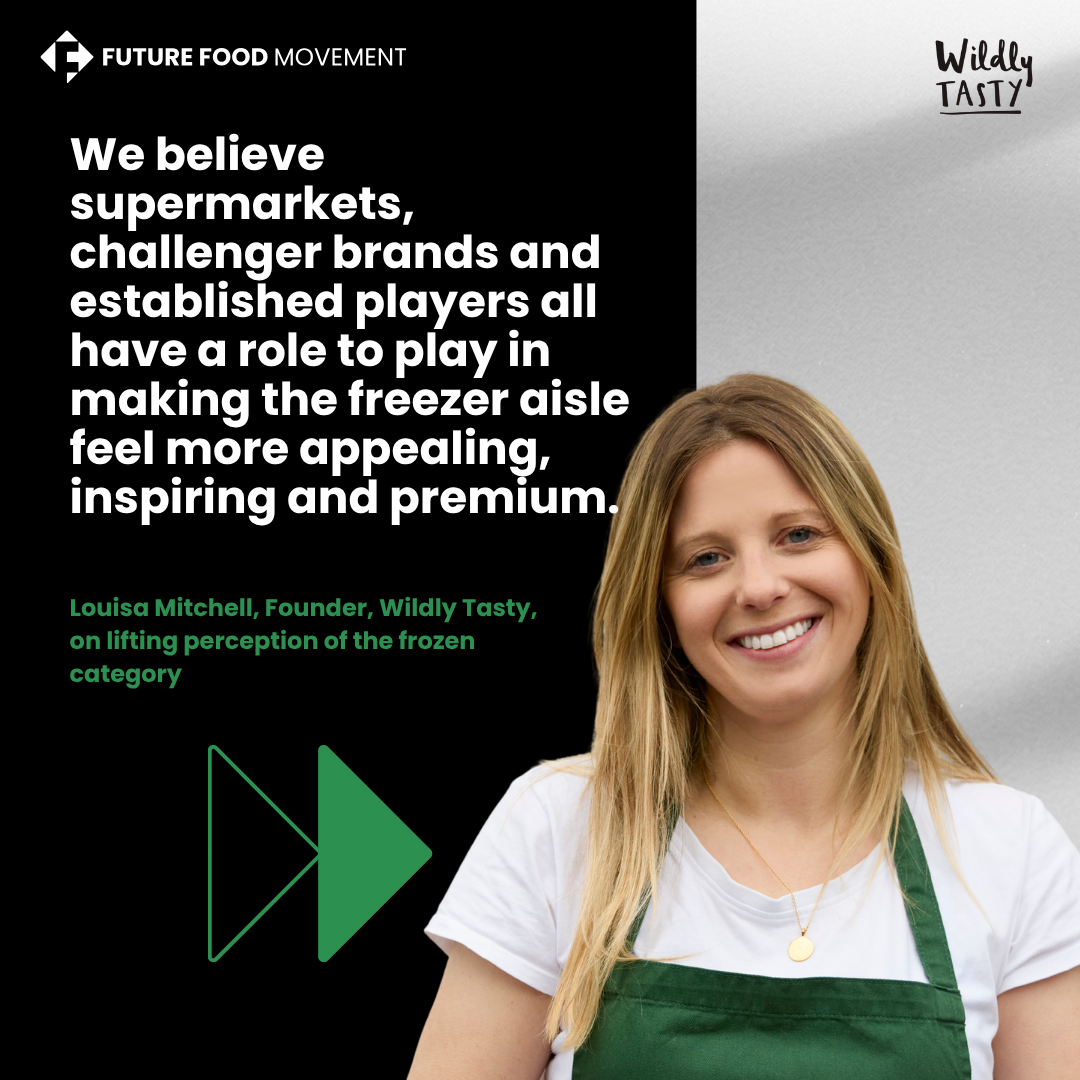
We believe supermarkets, challenger brands and established players all have a role to play in making the freezer aisle feel more appealing, inspiring and premium, and that's a really exciting opportunity for the category.
What made now the right time for Wildly Tasty to join Future Food Movement, and what are you hoping to gain from being part of the network?
At Wildly Tasty, our mission is to see more children enjoying eating plants, whether that's vegetables, fruit or pulses, supporting children's health while also helping them eat more kindly towards the planet.
Joining the Future Food Movement feels like a natural fit. We want to play a part towards better diets for children, both now and in the future, and the network gives us the opportunity to connect and collaborate with like-minded brands, suppliers and organisations who share that ambition.
We're also finding the regular insights and weekly newsletters particularly useful. They give us a valuable snapshot of the rapidly evolving food landscape, helping us stay informed about emerging trends, challenges and opportunities across the industry.
You went through the Food Systems Essentials Accelerator back in 2024. What's one thing from those four weeks that's still shaping a decision you're making today?
One of the biggest ways the Accelerator has continued to influence us is through the development of NPD. We have been working on a new range of products, addressing another important mealtime for families, breakfast, while applying what we'd learned about product development and the wider food system.
The programme challenged us to think carefully about how we approach the creation of new products, looking for ways to make products as nutrient-rich as possible. We've developed our vibrant new instant oats to contain 20% fruit, alongside hidden veg including beetroot.
It has also reinforced the importance of looking beyond the product itself and considering the wider supply chain. We've worked closely with suppliers who share our commitment to nature, from sourcing oats grown using regenerative farming practices to incorporating surplus air-dried apple and beetroot into our breakfasts.
The Accelerator encouraged us to continually ask how we can improve our products while collaborating with suppliers who are doing great work to protect nature. That's something that continues to shape our approach today and, ultimately, our contribution to a healthier food system.
What's the hardest trade-off you've had to navigate building Wildly Tasty, and how are you thinking about it differently now compared to when you started?
One of the biggest lessons for me has been learning the importance of staying focused rather than trying to do everything. When I launched Wildly Tasty, my initial plan was to build a much broader range. As we've grown, we've actually removed SKUs, even our family-size range, and deliberately kept the range focused, which has helped simplify the business and allowed us to concentrate on retail rather than DTC.
We also initially planned to scale production through our own kitchen, but two years ago we made the decision to outsource to a manufacturer with a handmade kitchen set up that already produces high-quality meals at scale. It's been a really positive decision, allowing us to stay lean, focus our energy on our suppliers, customers and sales, and scale alongside trusted production partners.
Importantly, scaling hasn't meant compromising on our values. We've been fortunate to continue working with suppliers we've worked with since day one, allowing us to continue sourcing specific, all-natural, high-quality ingredients as we grow.
What we're taking from this
Three things stand out to us.
The first is that Louisa isn't asking the freezer to compete with chilled on price. She's asking it to compete on quality perception, and she's clear that this only works if supermarkets, challengers and established players all push in the same direction. Category perception rarely shifts because one brand tries hard.
The second is the format decision. Selling a main that a parent finishes with their own rice or pasta, rather than a complete ready meal, is a small design choice with a lot behind it: cost per serve, portion flexibility across a wide age range, and the way parents feel about what they're putting on the table. We're seeing versions of that same move across the industry, where the winning product is often the one that leaves the customer something to do.
The third is that focus turned out to be the growth strategy. Cutting SKUs, dropping DTC and handing production to a partner all run against the instinct to expand and keep control. For a lot of small food businesses trying to reach retail with their sourcing standards intact, that combination is worth a close look.
If you're working on children's nutrition, or on shifting how shoppers read the frozen category, we'd like to hear what's actually moving the needle for you. Reply, comment, or bring it to the next member session.
Welcome to the network, Wildly Tasty. To learn more about Wildly Tasty, head to their website: https://www.wildlytasty.com/