
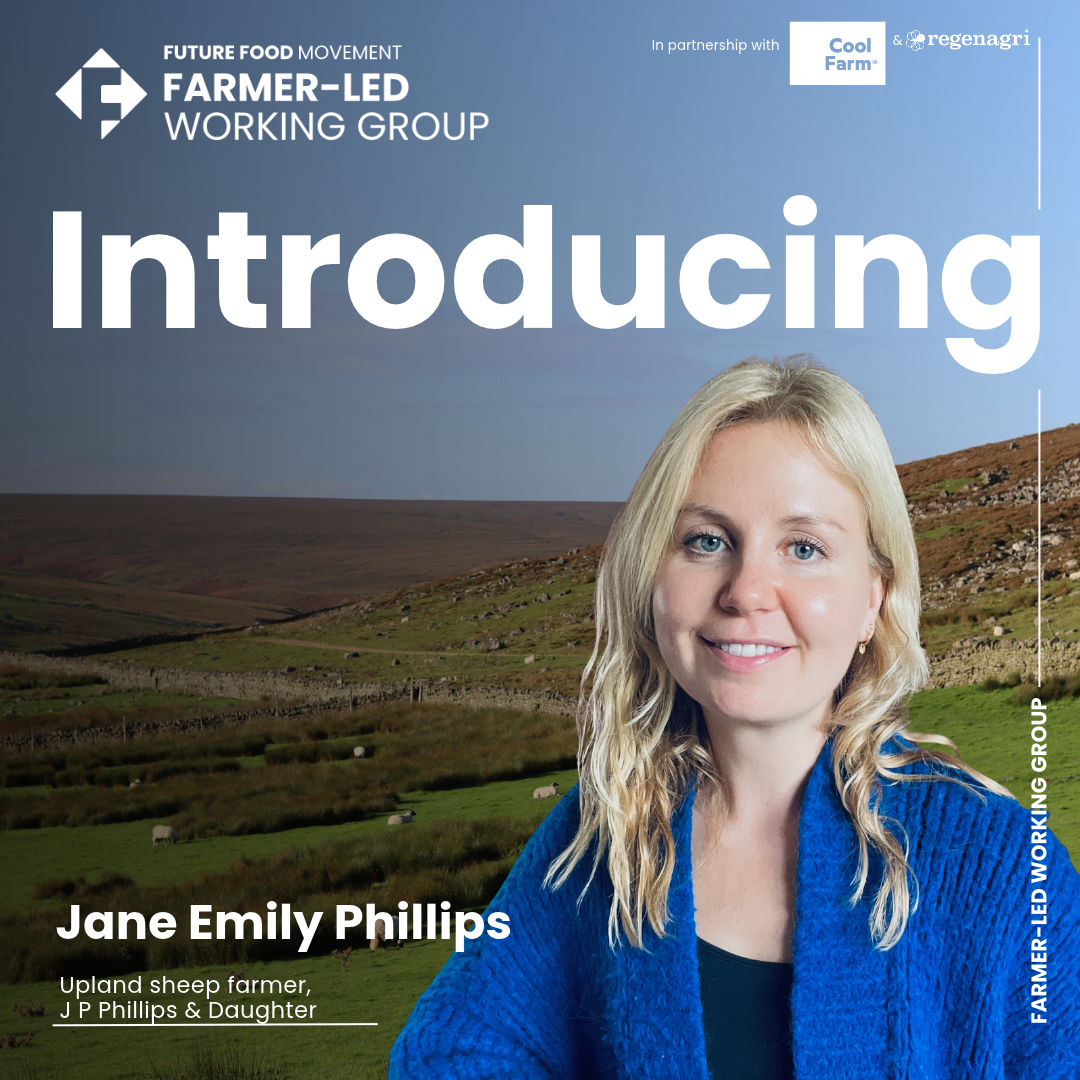
Jane Emily Phillips farms sheep with her father on their upland family farm in mid Wales, and has spent more than a decade making documentaries, including on food, farming and the environment. She joins our Farmer-Led Working Group as she wants to make sure the farms often left out of national conversations about food have a voice in them.
A lot of the land in the UK's uplands gets described as "marginal" or "less productive", due to limitations such as altitude, climate and soil conditions. For Jane, the value of upland farming goes beyond the food it produces.
"Sometimes we only think about output per hectare," Jane told us. "But I think we're losing the idea of the wider value that farms deliver, especially upland farms, those environmental and social benefits."
As she points out, well-managed grazing can support biodiversity, reduce wildfire risk in some landscapes and contribute to healthy soils and water management. Upland farms also hold rural communities together, along with generations of knowledge about how to look after these landscapes. She would like the food industry to recognise and reward that, rather than treat it as a side effect.
A family farm in the hills
Jane farms alongside her father on a low-input, mostly grass-based system, across longstanding permanent pasture and hill grazing. Traditionally a sheep and beef enterprise, the farm currently keeps sheep, with plans to introduce pigs and re-establish a cattle herd. They also performance-record their pedigree Lleyn flock through the Welsh Sheep Genetics Programme, selecting for traits including lamb growth, survival and parasite resistance.
They sell finished and store lambs through local livestock markets, which play an important economic and social role in rural communities, alongside selling breeding rams directly off-farm. Jane also supplies lamb, hogget and mutton directly to consumers and restaurants in Wales and London.
The store lamb trade is a good example of how interconnected British farming is. Upland farms form an important part of the UK's stratified sheep system, supplying store lambs to lowland farms for finishing, alongside breeding stock in some cases. Some of these lambs are finished on winter forage crops, such as swedes, or graze cover crops within mixed farming rotations, helping to cycle nutrients and integrate livestock into arable systems.
Jane wants the industry to recognise how these different systems depend on one another. "We need to consider the sustainability of these systems collectively, rather than viewing them as competing approaches." Losing upland producers could have consequences far beyond the hills themselves.
What both ends of the chain show her
Jane started selling direct to restaurants because, through livestock markets, "you're beholden to commodity prices. So it was a way to add value to our produce." She has found that chefs genuinely care where their meat comes from, and that the provenance story gives diners a real connection to their food.
The restaurants she works with use the whole carcass, offal included, and design menus around it. However some restaurants only want prime cuts in a uniform shape. Add a loss of knowledge among consumers about how to cook less popular cuts, and you get a carcass balance problem that she sees across the whole industry.
Local abattoirs are the other pressure point. One of the two the farm uses is a long way away, and she knows abattoirs are under a lot of pressure. For smaller producers trying to add value and sell direct, she sees those abattoirs as key to keeping local supply chains going.
Getting the story right
Jane has spent more than ten years producing documentaries for broadcasters including the BBC and National Geographic. She now combines farming with documentary production, journalism and communications on food, farming and the environment, so she knows what good storytelling can do.
"Documentaries and storytelling can be incredibly powerful in connecting people with the human stories behind these abstract concepts," she said. Headlines are full of statistics, and the people and the nuance behind them tend to get lost. She also believes you don't have to romanticise farming to tell a compelling story about it.
She also sees where coverage falls short, particularly on livestock. Global assessments of livestock's environmental impact are often used to shape stories about UK farming, without enough attention to differences in production systems, land use and environmental outcomes.
Part of the fix, she thinks, is a closer connection between the people telling these stories, whether producers or journalists, and the farming community itself.
Why she joined
Jane has noticed that "the voices of smaller family farms, particularly those farming land often described as 'marginal', aren't always represented in national conversations about the future of food and farming." She has also seen how disconnected farms like hers can be from the processors, retailers and consumers further along the chain.
She thinks that gap runs both ways. "Maybe farmers don't necessarily understand the commercial pressures of the supply chain, like processors, retailers, but also vice versa. Being able to sit in the same room with those people and hopefully bridge that gap a bit, I think would be really insightful."
The uplands are a good place to start. They carry competing pressures from food production, nature recovery and climate mitigation, and Jane is clear that the choice between them is "not binary". In her view, farming and nature recovery can be combined, and upland farming communities are part of the social and cultural fabric of rural Wales, the Welsh language included.
The question she brings to the group
Jane left us with a question that every business in the chain has a stake in:
"How do we design a sustainable food system that rewards efficiency without inadvertently accelerating the disappearance of smaller farms, traditional grazing systems and the rural infrastructure on which they depend?"
She joins her first combined Farmer-Led Working Group session, with farmers and food businesses in the same room, this week. If your business sources lamb or beef, or is working on provenance and supply resilience, we'd like to hear how you're weighing up that trade-off, get in touch with the team.
Enjoyed this?
Join Future Food Movement to be part of the conversation shaping the UK food system.
[Become a member →]