Why the next generation of leaders will shape whether food system transformation actually happens
Across the UK food sector there is no shortage of ambition on climate, health, nature and supply resilience. But a question is increasingly surfacing across boardrooms, supply chains and farm gates. Can we actually deliver all of this?
As featured in The Grocer, Our recent leadership briefing, Execution at Risk, explored this question with leaders from across farming, manufacturing, retail and finance. A clear pattern emerged - the food sector does not lack strategy. What it increasingly lacks is the leadership capability inside organisations to deliver systemic change under real commercial pressure.
The result is a widening gap between ambition and delivery, and that gap is increasingly landing with a new generation of leaders. Across the sector, future CEOs, CFOs, strategy and sustainability leaders are already navigating these tensions every day. They are translating long term commitments into operational decisions, balancing cost pressure with climate goals and managing supply chains that must become more resilient while still delivering affordability.
Many are doing this before they formally hold executive authority. They are influencing strategy across organisations, shaping debates about product portfolios and supply chain resilience while still operating one step below the C-suite.
Kate Cawley, Founder of Future Food Movement, describes this moment as a leadership inflection point. “The food system doesn’t have an ambition problem. It has a delivery problem. The question now is whether the industry is investing seriously enough in the people who will have to translate those commitments into decisions about products, supply chains and capital.”
The leadership challenge is not only about sustainability knowledge. It is about navigating complexity across commercial performance, risk, stakeholder expectations and long term resilience. Chris Hatcher, Partner at Redgrave, sees this clearly in the leadership market. “While sustainability is widely recognised as important, it is rarely a primary criterion for senior leadership roles. Boards still prioritise financial, operational and commercial experience, which reflects the immediate pressures businesses face. This creates a pipeline issue. There are relatively few leaders who combine deep commercial credibility with sustainability literacy.”
The pressure is also visible across the supply chain. Cynog Davies, a beef, sheep and arable farmer who contributed to the research, captured the reality clearly. “Farmers are being asked to change how we produce food faster than ever before. Most of us want to be part of that transition. But you’re being asked to invest in improvements that take years to deliver while the market signals remain short term and price driven.”
In addition to farmers this tension is also seen from the retail side as Nigel Murray, CEO of Booths and part of the Future Food Movement leadership network explains. “Retailers operate where consumer expectations, commercial reality and supply chain considerations all collide. The direction of travel on health, sustainability and resilience is clear, however good intentions alone won’t deliver change. The shared ambition must be matched with aligned action in every part of the food system.”
These tensions raise a deeper question for the sector. What kind of food system are today’s emerging leaders being asked to lead? Many are stepping into an industry where climate risk, supply resilience and public trust are reshaping the landscape simultaneously. They are inheriting a system that must deliver affordability, resilience and environmental transition at the same time, often within governance structures designed for a different era.
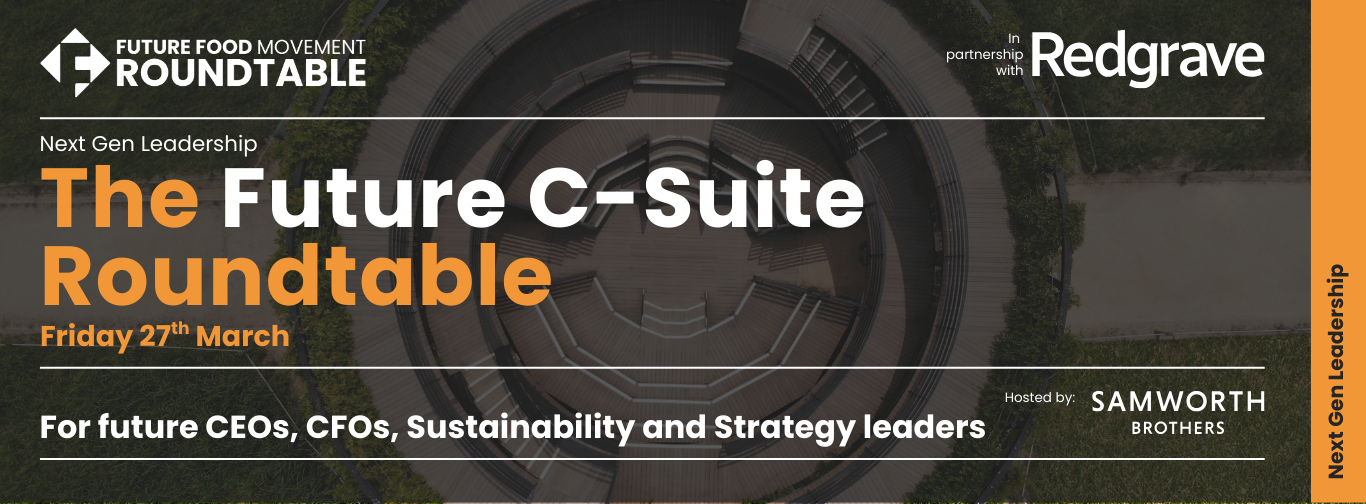
This thinking sits behind the Next Gen Leadership – Future C-Suite Roundtables convened by Future Food Movement and Redgrave, hosted by Samworth Brothers. We’re bringing together emerging leaders from across retail, manufacturing, farming and finance to explore what leadership inside the food system now requires.
If the industry wants to close the gap between ambition and delivery, it must look carefully at the leadership pipeline inside organisations. Ambition has never been the sector’s problem. Execution now is, and execution ultimately depends on people.
The leaders stepping into the next generation of the C-suite will shape not only the future of their organisations, but the resilience of the entire food system. The question is whether the industry is preparing them well enough for the responsibility they are about to inherit.
If you want to be part of the conversations shaping the future of the food system, join Future Food Movement.