
Execution at Risk: Why Capability, Not Ambition, Will Determine the Future of Food
Kate Cawley | Future Food Movement; Founder and Managing Director
There is no shortage of ambition in the food sector. Across retail, manufacturing, agriculture, finance and foodservice, organisations have set targets on health, climate and resilience. The direction of travel is clear.
And yet, in conversation after conversation across our network, a more uncomfortable reality emerges.
Delivery feels fragile.
Execution at Risk comes from the richness of the Future Food Movement network. Based on our survey of 100 professionals, combined with insight from our Thinking Partner Network, Farmer-Led Working Groups, Transformation Table and Expert Events, alongside perspectives from senior leaders working at the centre of commercial decision-making. It reflects what leaders are experiencing in real time.
Where confidence breaks down
One pattern stood out clearly. Confidence is relatively strong when discussing strategy, reporting and technical frameworks. It drops sharply when sustainability intersects with commercial trade-offs and cross-functional authority. This is where execution risk lives.
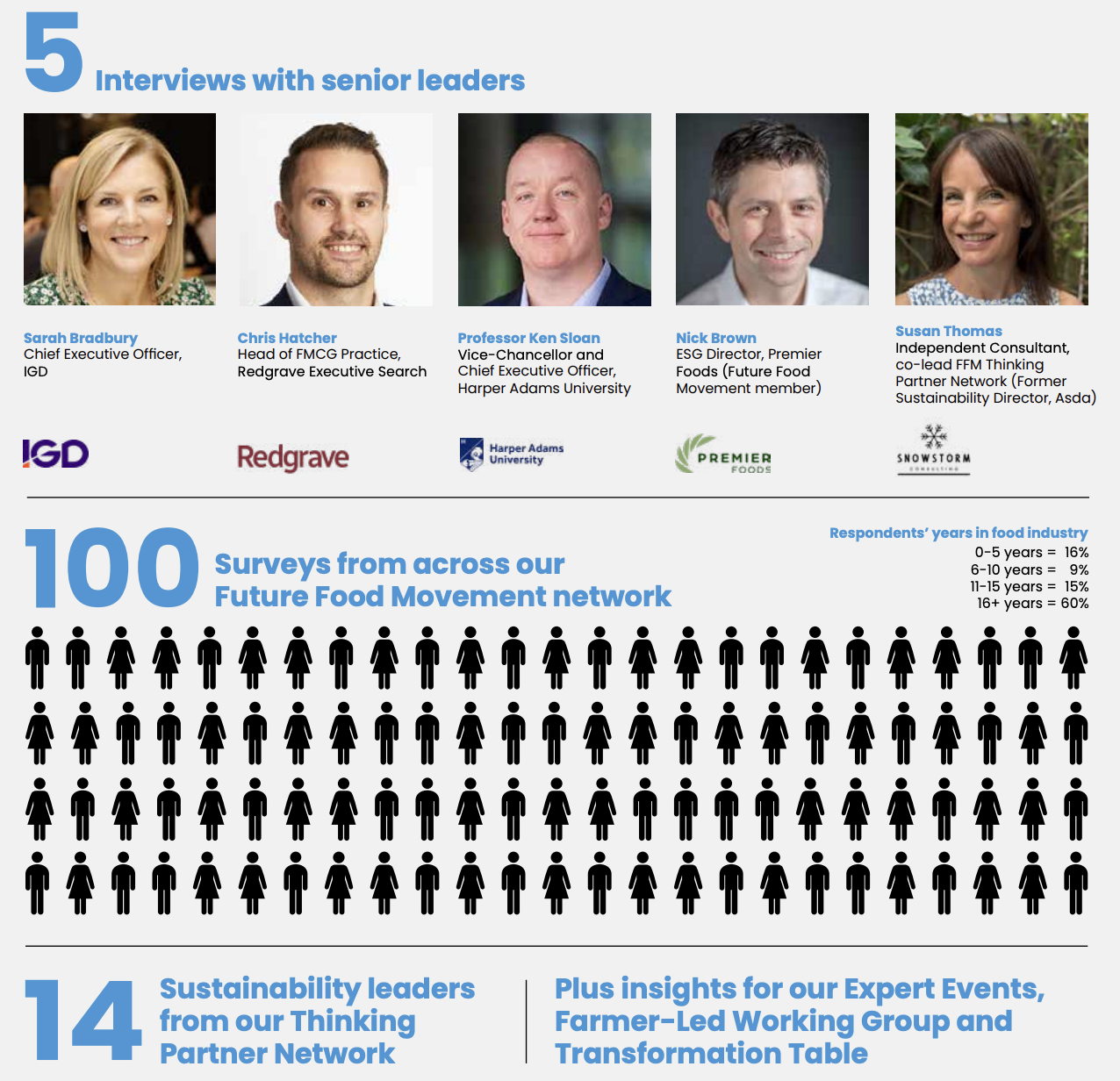
Sarah Bradbury, Chief Executive Officer at IGD, captures the underlying tension. Collective action takes time, yet commercial environments reward immediate results. That tension slows progress, even when intent is strong. In other words, the system is asking leaders to deliver long-term transformation while being governed by short-term performance cycles.
As Susan Thomas, co-facilitator of our Thinking Partner Network and former Sustainability Director at Asda, has observed, when short-term performance dominates leadership attention, everything else becomes secondary, regardless of what the strategy says. Cultural reinforcement and governance design matter more than statements of intent.
Nick Brown, ESG Director at Premier Foods, points to the importance of embedding sustainability into governance and planning cycles. Treating sustainability as a resilience issue rather than a reporting exercise changes how the whole organisation engages. When it sits inside core decision-making, delivery becomes more consistent.
Chris Hatcher, Head of FMCG Practice at Redgrave Executive Search, highlights another structural constraint: the leadership pipeline. Boards are seeking leaders who combine commercial credibility with sustainability literacy, yet the market for that blend of capability is thin. Recruitment alone will not solve the gap.
Professor Ken Sloan, Vice-Chancellor and Chief Executive at Harper Adams University, reinforces that future leaders will need to operate across interconnected systems, not just within functions. Technical expertise alone will not prepare people for the complexity the sector now faces.
These are not abstract reflections. They are signals from across the system.
Execution capability as a strategic differentiator
Execution risk is not about lack of ambition. It is about whether organisations are structurally built to deliver under pressure. The organisations making steady progress are not necessarily those with the boldest targets. They are those aligning incentives, clarifying ownership and building cross-functional literacy. They are investing in internal capability, not relying solely on specialist teams or external recruitment.
Execution capability is emerging as a strategic differentiator.
As volatility increases and scrutiny intensifies, the ability to navigate trade-offs consistently will separate those who shape the future from those who react to events.
A collective signal from the network
This report is a collective signal from the Future Food Movement network, from our Expert Events, Farmer-Led Working Group, Thinking Partner Network.
From commercial leaders and board members navigating real trade-offs.
By combining quantitative survey data with practitioner experience and leadership perspectives, Execution at Risk aims to surface where delivery is most exposed and where practical shifts can strengthen it.
There is no single solution. But there are clear patterns.
If we want transformation to be durable, we have to move beyond ambition and redesign how delivery actually happens inside organisations.
The full report is available to download here.
Future Food Movement supports teams throughout the food sector to assess:
Where execution risk may exist
Which capability gaps matter most
What practical actions would strengthen delivery
How to align stakeholders around a shared plan.
Take 1 minute to tell us your opportunities to unlock your team’s potential here.