
Future Food Movement: Food System Signals & Field Notes
By Kate Cawley, Founder
One of the privileges of the work we do at Future Food Movement is the vantage point it gives across the food system, on any given week we might be in conversation with farmers, retailers, manufacturers, investors, sustainability leaders, commercial teams and a new generation of executives coming through the sector. Those perspectives rarely sit in the same room, yet they are all part of the same system and responding to many of the same pressures. Over time I’ve realised those conversations give a slightly unusual vantage point. You start to hear things before they appear in reports or conference presentations. Not big announcements or headline trends, but small shifts in tone, the questions people are asking and the tensions that keep resurfacing. So I thought I’d start sharing a few of those observations from time to time, nothing too formal just some field notes from inside the system and the signals that seem to be quietly gathering momentum.
One that has been surfacing repeatedly recently is the capability question (and why we produced our recent report Execution at Risk). Across the sector there is no shortage of ambition, we have serious climate commitments, nature strategies, reformulation programmes, supply chain resilience plans. The intent is clearly there but in conversation after conversation the same reflection is appearing: delivering these ambitions inside complex businesses is proving far harder than setting them. It requires commercial teams, procurement, marketing, sustainability and operations to work together in ways that many organisations weren’t originally designed for. Different incentives, different priorities, different rhythms. Strategy isn’t really the constraint any more the harder part is execution.
Another shift I’ve been noticing is around trust. We are moving into a world where commentary, content and polished messaging can be produced endlessly. Paradoxically that seems to be making people place more value on visible expertise, judgement and lived experience. Less appetite for perfectly packaged narratives and more interest in signals that feel grounded in reality. In the food sector that could become quite important, because farming relationships, supply chains and product craft are genuine assets if businesses choose to surface them. A third pattern is where the most honest conversations are actually happening, not particularly on public platforms and often not on conference stages either (a relief for me as not always something I’m good or comfortable with!) Increasingly it is in smaller groups or private discussions where people feel able to speak more openly about the tensions they are navigating – cost pressures alongside climate commitments, health ambitions alongside affordability, the realities of supply chains alongside the expectations placed on them. Those spaces matter because they allow leaders to test ideas, challenge assumptions and learn from others facing similar dilemmas.
And then there is leadership culture.
With 20 years to reflect on this, I can quite confidently say that across the organisations that seem to be making the most progress, the differentiator rarely appears to be the strategy itself. More often it’s the way leaders work together across functions, the willingness to listen to perspectives from other parts of the system, and the openness to rethink how decisions are made. Food is an extraordinarily interconnected system, that means the quality of relationships inside organisations and between organisations, matters more than we sometimes acknowledge.
These aren’t conclusions, more observations from the last few weeks of conversations. If it’s useful, I’ll share a few more of these field notes from time to time. I’d also be really interested to hear what others are noticing from inside their own organisations.
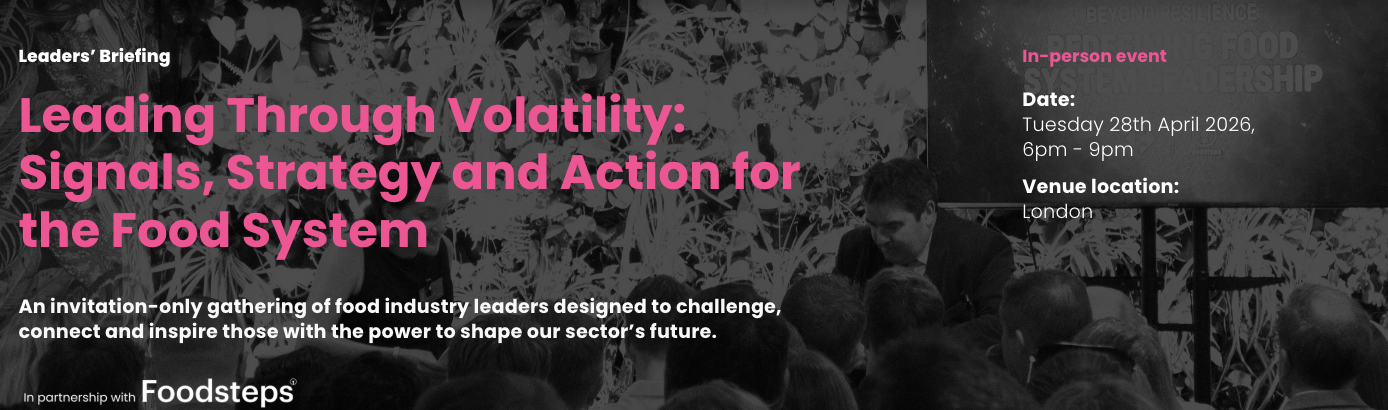
We’re bringing together an interesting group of senior leaders for our next Future Food Movement x Foodsteps Leaders’ Briefing on 28th April, If you’re navigating these decisions and want to be in the room, register your interest and we’ll be in touch.