
SBTi Net-Zero Standard V2.0: What Food Businesses Need to Know
The reality of net zero in 2026 is that we are firmly in what many organisations would describe as the messy middle.
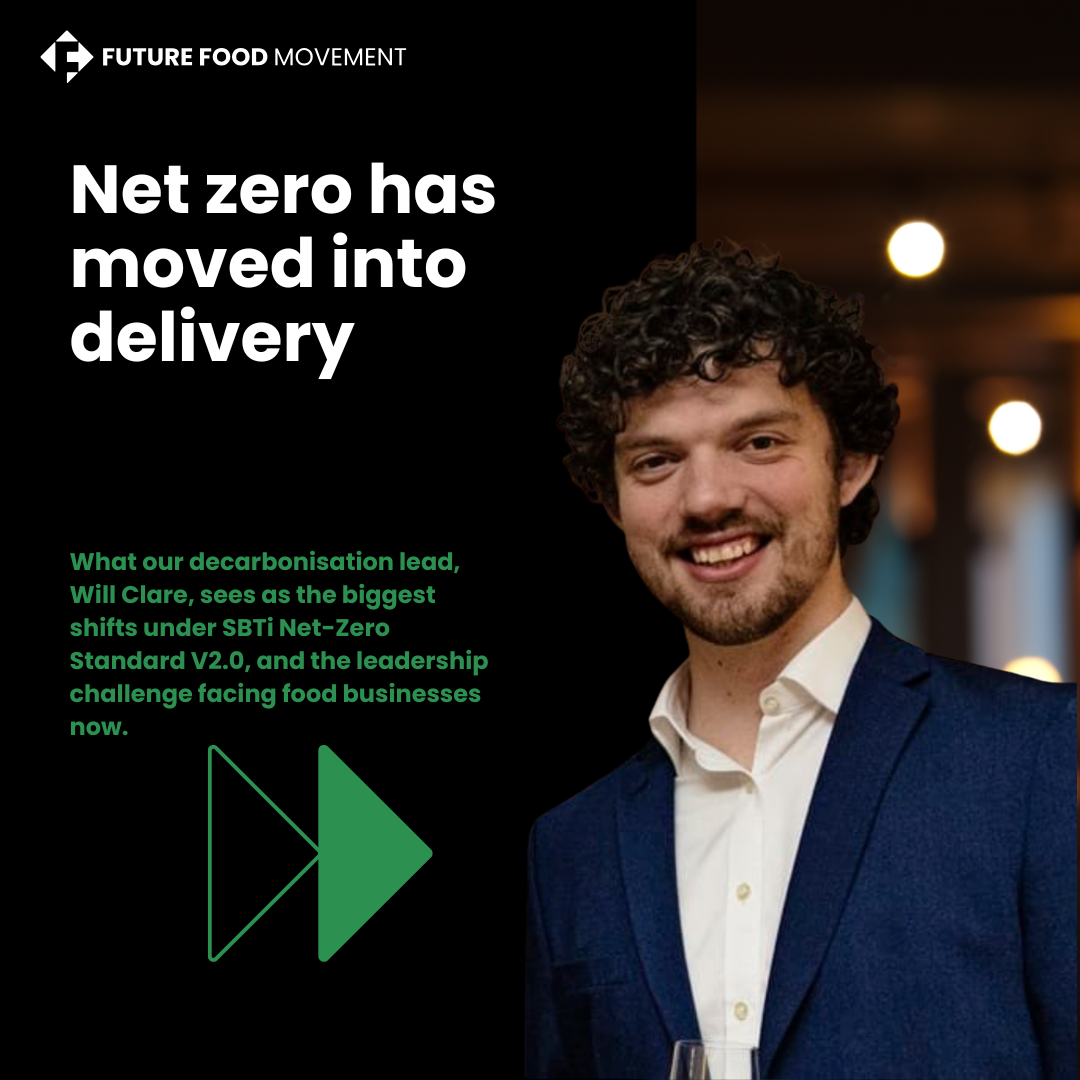
Over the past five years, much of the focus has been on setting targets, establishing baselines, building reporting frameworks and developing climate strategies. Today, most food businesses have moved beyond the question of whether they should act. The challenge is increasingly where to focus finite capital, resources and influence to achieve the greatest impact.
Climate change is no longer a future risk, nor is decarbonisation an emerging opportunity. Both are now embedded within day-to-day business decision making.
Against a backdrop of increasing climate disruption, evolving regulation, investor scrutiny and uneven political support, net zero has entered its delivery phase. Success will increasingly be determined not by the targets organisations set, but by the actions they prioritise, the investments they make and the outcomes they can demonstrate.
The Science Based Targets initiative (SBTi) Corporate Net-Zero Standard V2.0 reflects this shift.
While the technical updates are important, the bigger signal is that net zero is moving from a target-setting exercise to a business transformation challenge.
For food businesses, the implications extend far beyond sustainability teams.
Jump to section
What has changed?
1. Scope 3 becomes more focused
What changed?
For many food businesses, Scope 3 emissions account for more than 90% of total emissions. Under V2.0, there is greater emphasis on prioritising material emissions sources and directing effort towards the areas that matter most.
This means organisations can focus resources on key hotspots such as agricultural commodities, land use, packaging and logistics, rather than spending disproportionate effort on smaller emissions sources that have limited impact on overall performance.
Why it matters
This should help businesses focus effort and investment where the greatest emissions reductions can be achieved rather than attempting to treat every emissions source equally.
For food businesses in particular, it creates a stronger basis for prioritising supplier engagement, sourcing strategies and agricultural interventions.
Leadership question
Are we focusing our resources on the emissions sources that will genuinely move the dial, or are we spreading effort too thinly across lower-impact activities?
2. Greater recognition of the realities of Scope 1 decarbonisation
What changed?
The new standard introduces dedicated Scope 1 targets and places greater emphasis on asset transition and decarbonisation planning.
This better reflects how emissions reductions happen in practice. Food businesses rarely reduce emissions in a smooth, linear way. Progress often comes through step changes such as replacing equipment, electrifying fleets, upgrading refrigeration systems or transitioning away from fossil fuels.
Why it matters
The focus shifts from achieving annual reductions on paper towards demonstrating a credible pathway for operational decarbonisation.
This creates a stronger connection between climate targets and long-term capital investment planning.
Leadership question
Do our investment plans and asset replacement cycles align with our climate commitments?
3. Agriculture, land use and nature become more central
What changed?
One of the most significant developments for the food sector is the integration of land-sector accounting through the Land Sector and Removals Guidance (LSRG).
This creates a clearer framework for recognising the role of soil carbon, land management, ecosystem restoration and other land-based activities within climate strategies.
Why it matters
For food businesses, this brings climate, nature, biodiversity and regenerative agriculture into closer alignment.
Rather than treating these as separate agendas, organisations can begin building more integrated approaches that deliver multiple outcomes across agricultural supply chains.
It also strengthens the case for investing in farm-level interventions that contribute to emissions reductions, resilience and environmental improvement simultaneously.
Leadership question
How are we prioritising climate, nature and resilience investments across our farming and sourcing programmes?
4. More focus on implementation and transition planning
What changed?
Climate targets are no longer viewed as standalone commitments.
The new standard places greater emphasis on how businesses intend to deliver their targets through procurement decisions, capital investment, operational improvements and supplier engagement.
Why it matters
The focus moves beyond target setting and reporting towards demonstrating a credible transition plan.
For food businesses, this means decarbonisation is increasingly becoming a commercial decision lever, a supply chain strategy and an operational transformation programme.
Aligning to V2.0 signals to investors, customers and other stakeholders that the business understands both the risks and opportunities associated with the transition.
Leadership question
Can we clearly demonstrate how our climate targets are embedded into commercial, operational and investment decisions?
5. Increased expectations around reporting and assurance
What changed?
The standard introduces stronger requirements around tracking, reporting and validating progress.
Businesses will increasingly be expected to demonstrate not only what emissions reductions have been achieved, but also the actions that delivered them and how these align with wider transition plans.
Why it matters
Climate data is increasingly being treated with the same level of rigour expected of financial information.
Stakeholders are looking beyond commitments and increasingly seeking evidence of delivery.
This raises the importance of robust data, governance and assurance processes.
Leadership question
Do we have sufficient confidence in our data, reporting and governance processes to withstand increasing scrutiny?
6. Looking beyond target achievement to target maintenance
What changed?
V2.0 introduces a broader framework for addressing ongoing emissions and recognising wider climate contributions.
Alongside emissions reduction targets, there is increasing recognition of the role businesses can play in supporting carbon removals, nature-based solutions and other climate mitigation activities beyond their direct value chain.
Why it matters
For the food sector, where land-based emissions reductions and removals often interact across multiple products, suppliers and sectors, this creates both opportunities and responsibilities around transparency, allocation and environmental claims.
Organisations will need to demonstrate clear governance and credible evidence to support any claims associated with removals or climate contributions.
Leadership question
How are we balancing emissions reductions, removals and broader climate contributions within a credible long-term strategy?
What does this mean for food businesses?
The biggest message from SBTi V2.0 is that climate action and net zero have matured.
Success will increasingly be judged not by the ambition of a target alone, but by the credibility of the plan behind it and the evidence that progress is being delivered.
For food businesses, this means focusing on the emissions sources that matter most, integrating climate action into operational and investment decisions and recognising the growing role that agriculture, land management and nature restoration can play in delivering long-term value.
Perhaps most importantly, V2.0 highlights a challenge we see consistently across the food system.
The barrier is rarely a lack of awareness.
Most organisations understand the climate challenge and recognise the strategic importance of net zero. The harder question is how procurement, agriculture, operations, finance, sustainability and commercial teams make decisions when cost, resilience, growth and climate goals are all competing for attention.
Increasingly, the challenge is becoming less about climate literacy and more about organisational capability.
The organisations best positioned for the next phase of net-zero action will not necessarily be those with the most ambitious targets. They will be those that can align functions, prioritise investment and demonstrate how sustainability is embedded across their business, from farm to factory to consumer.
Beyond Target Setting: What Accountability Looks Like in Practice
One of the most common questions emerging from the updated standard is also one of the most important:
What happens if a business misses its net-zero target?
The simple answer is that SBTi remains a voluntary framework. Unlike regulation, there are no direct financial penalties for failing to achieve a target.
However, that does not mean there are no consequences.
Increasingly, accountability is shifting from whether an organisation has a target to whether it can demonstrate a credible plan, transparent progress and clear decision making.
For food businesses, the implications are likely to be felt through multiple routes.
Investors are placing greater emphasis on transition plans, governance and evidence of delivery. Retailers and customers increasingly rely on supplier emissions reductions to support their own climate commitments. Regulators continue to move towards more robust climate disclosure requirements. And stakeholders are becoming more interested in progress than promises.
Perhaps most importantly, organisations that cannot demonstrate credible action may face growing questions around resilience, leadership capability and long-term competitiveness.
At the same time, food businesses operate within complex and often unpredictable systems.
Extreme weather, supply chain disruption, changing consumer demand, geopolitical instability and fluctuating commodity markets can all influence emissions trajectories in ways that are difficult to predict.
This raises an important question.
Should success be measured solely by whether a business achieves its target, or by whether it is making the best possible decisions to drive meaningful progress?
A company may miss an emissions milestone while still making strong strategic decisions, investing in long-term supply chain resilience and delivering significant emissions reductions where it has the greatest influence.
Equally, a business may technically achieve a target while doing little to address the underlying challenges facing its value chain.
Future Food Movement's Perspective
At Future Food Movement, we believe the purpose of a net-zero target is not to create a perfect prediction of the future.
It is to create a credible direction of travel, align decision making and accelerate action.
In a food system increasingly shaped by climate disruption, geopolitical instability, supply chain volatility and changing consumer demand, very few organisations will follow a perfectly linear pathway to net zero.
What matters is whether the business can demonstrate that it is making informed decisions, investing in the right areas and delivering meaningful progress against the emissions sources where it has the greatest influence.
Missing a target should trigger learning, transparency and course correction, not silence.
The organisations most likely to succeed will be those that can clearly explain:
What progress has been made
Where challenges have emerged
What decisions have been taken in response
How future actions and investments will accelerate progress
In other words, accountability is increasingly moving beyond target ownership towards transition leadership.
The question is no longer simply:
"Did you hit the target?"
It is becoming:
"Can you demonstrate a credible transition plan, evidence of progress and confidence that the business is making the right decisions for the long term?"
For food businesses in particular, this requires climate action to move beyond sustainability teams and become embedded within procurement, agriculture, operations, finance and commercial decision making.
This is one of the biggest implications of SBTi V2.0.
The challenge facing most organisations is no longer understanding climate change or setting ambitious targets. The challenge is building the capability, governance and cross-functional alignment required to deliver them.
Because ultimately, net zero is not a reporting challenge.
It is a business transformation challenge.
Speak to us: one-to-one support on decarbonisation
If you’d like to book a one-to-one call with Will Clare, our Decarbonisation lead, email us at hello@futurefoodmovement.com and we will book you in.
In these sessions, you can explore:
The most important changes within the new standard
The implications for Scope 3, FLAG and agricultural supply chains
How leading organisations are approaching transition planning
Where businesses should focus effort, investment and leadership attention
What accountability, credibility and success look like in the next phase of net-zero delivery
Because the challenge facing most organisations is no longer understanding net zero, it's deciding how to deliver it.
How Future Food Movement Can Help
Future Food Movement supports organisations moving from climate ambition to practical delivery.
Our work includes:
Developing SBTi-aligned corporate inventories and FLAG reporting that support decision making, not just disclosure
Identifying supply chain hotspots through product carbon footprinting and decision intelligence tools
Translating emissions data into actionable insights linked directly to business priorities and investment decisions
Building credible transition plans that integrate climate, commercial, nature and resilience objectives
Supporting leadership teams to navigate the trade-offs, capabilities and organisational change required to deliver net-zero commitments
As climate expectations continue to evolve, the organisations that succeed will be those able to turn data into decisions and ambition into action.
Join us at London Climate Action Week (LCAW)
We’ll also be hosting a Climate Risk-focused event during LCAW, in partnership with Mitie and Climate X exploring climate risk, operational resilience and business continuity across the food and beverage industry. Join us to hear how physical climate exposure is affecting estates, assets, infrastructure, operations and long-term resilience planning.
Sign up to Food Systems Essentials Accelerator
Built for teams moving from net-zero targets to delivery, the Accelerator supports decision-making across pricing, sourcing, investment and supply.
Designed for those operating in the “messy middle”, it builds the confidence, language and systems view needed to act under commercial pressure.
Delivered in four short online sessions, it focuses on turning climate ambition into practical action, quickly.