
Welcoming new farmers to the Future Food Movement Farmer-Led Working Group
One of the most important principles behind Future Food Movement is simple. If we want to transform the food system, farmers have to be part of shaping the conversation.
Too often the future of food is discussed in boardrooms, policy circles and conferences without the people producing the food sitting in the room. The Farmer-Led Working Group was created to change that. It brings farmers and food industry leaders together in small, confidential sessions to explore the realities shaping supply chains and to build more practical collaboration across the sector.
Over the past year the group has grown steadily as more farmers choose to contribute their insight, experience and leadership to the conversation. We’re proud to convene this group in partnership with Cool farm and Regenagri.
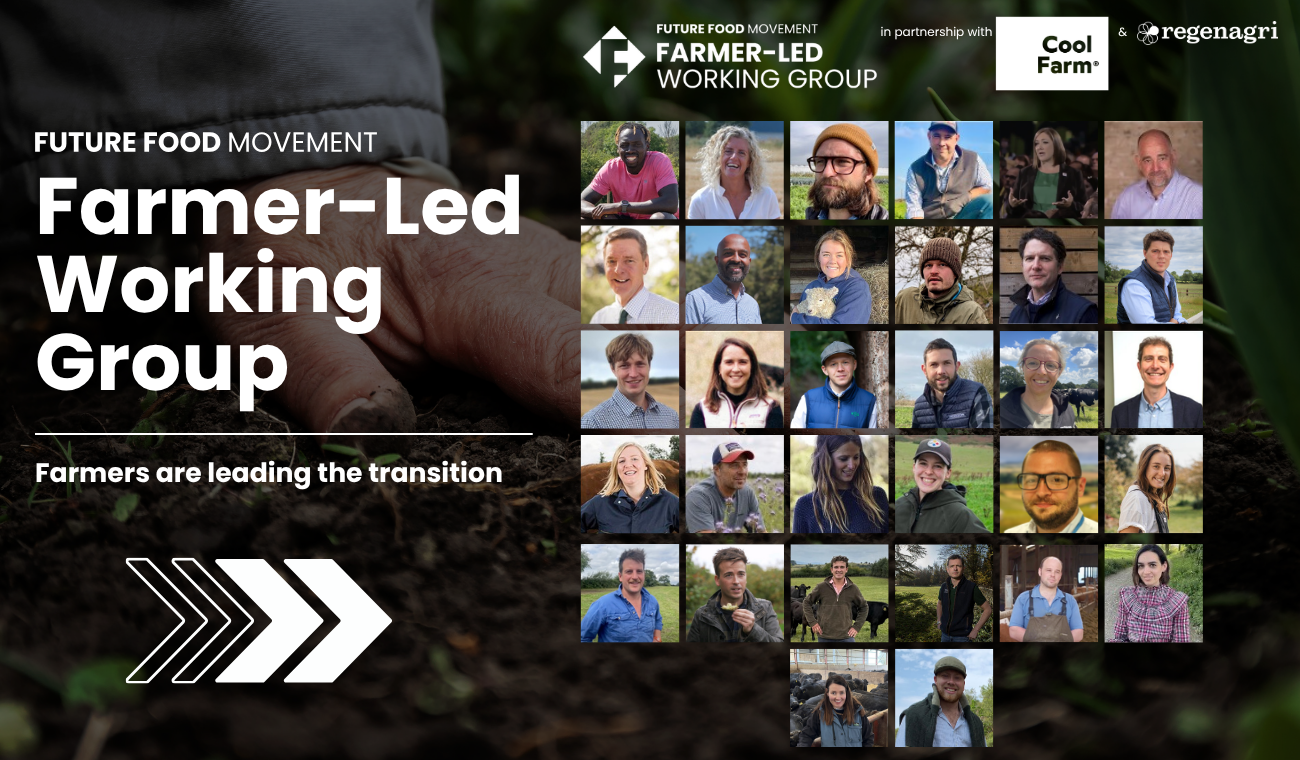
We are delighted to welcome several new farmers into the network.
Tim Parton – Green Farm Collective
Tim Parton is a farm manager in South Staffordshire and one of the UK’s most recognised regenerative farming advocates. His approach focuses on soil biology and plant nutrition to replace synthetic inputs, with the aim of producing more nutrient-dense food while restoring soil health. Tim is also a director of the Green Farm Collective, working to develop markets for regenerative produce and natural capital.
Tim joined the group because of a belief that regenerating the planet and its ecosystems is a shared responsibility across the food system.
Douglas Bowden-Smith – Pittarthie Farm
Douglas Bowden-Smith is a partner in family farming enterprises in Suffolk and Fife and works with Scotland’s federal agri-co-operative, SAOS. Through his work with farmer-owned co-operatives he has a unique view of the challenges facing primary producers across the UK, from climate transition to global commodity pressures.
Douglas joined the working group to ensure farmers’ voices are heard in shaping the future of food production and land management, and to bring a co-operative, systems-level perspective to the discussion.
Vicki Lintern – Rumbullion Farm
Vicki Lintern farms regeneratively at Rumbullion Farm while also leading Emissions Intelligence at Mitie. Her work bridges two worlds, practical regenerative farming and enterprise-scale climate strategy.
At Rumbullion Farm she is developing a full agroforestry plan to restore biodiversity and experiment with carbon measurement. Through her role at Mitie she helps organisations measure and reduce emissions across complex operations.
Vicki believes farms are not just food producers but powerful climate actors, and brings both technical and land-based insight to the working group.
Dr Johnny Wake – Courteenhall Farms
Johnny Wake is Managing Partner of Courteenhall Farms in Northamptonshire, a diverse rural estate that has transitioned towards regenerative agriculture with a strong focus on soil health and biodiversity.
Alongside farming he plays a significant leadership role across the sector. He founded the Tove Valley Cluster Farm group, chairs the Central England region of the Environmental Farmers Group and is a trustee of LEAF. His work reflects a strong commitment to making farming both environmentally and economically sustainable.
Tom Cannon – Roughway Farm
Tom Cannon represents a farming family that has been producing food in Kent for generations. At Roughway Farm he has helped diversify the business into cobnuts, fruit and other crops while exploring new markets for British hazelnuts.
Tom is chairman of the Kentish Cobnuts Association and a Churchill Fellow who has researched hazelnut production around the world. His work reflects a wider interest in diversification, regional food culture and strengthening the role of local food systems.
Cynog Davies – Cloverfields
Cynog Davies farms beef, sheep and arable systems at Cloverfields. His passion lies at the intersection of farming and business, with a strong interest in how markets and supply chains shape outcomes on farm.
Cynog is particularly focused on transparency in food labelling, believing clearer information about origin, breed and production systems would allow higher quality food to compete more fairly in the marketplace.
Jane Oosterhof- Savoch Farms
Jane farms a mixed arable and livestock farm in Aberdeenshire. Her work on the farm is mostly linked to her and her family's extensive cattle finishing enterprise, and she also manage a small flock of Easy-Care breeding sheep. Aside from the farm Jane works part time as an Agricultural Consultant, providing a wide range of farm management and subsidy advice. Jane is also a 2026 UK Nuffield Farming Scholar studying how the journey to net zero impacts profitability and scale of production on UK beef farms.
Why farmers are joining
Across the group there are different farming systems, geographies and perspectives. But several common motivations come through clearly.
Farmers want their voices heard in shaping the transition to a more sustainable food system.
They want stronger collaboration with the supply chain, government and consumers
They want recognition for the wider value farming delivers, from biodiversity and climate mitigation to nutrient-rich food.
And they want to help build a food system that is economically viable for the people producing the food.
These conversations are not theoretical. They explore the structural tensions farmers navigate every day, from shifting sustainability requirements to price volatility and unclear long-term signals from the market.
Why this matters for business leaders
For Future Food Movement members across retail, manufacturing and finance, the Farmer-Led Working Group provides something that is surprisingly rare in the food system: direct, unfiltered insight from the people producing the food.
Many businesses are setting ambitious targets on climate, nature, nutrition and supply chain resilience. But the success of those commitments ultimately depends on decisions made on farms.
Through these sessions, members gain:
Early insight into supply chain risks and realities
Farmers are often the first to see the impacts of climate volatility, input costs, policy shifts and changing land use. Hearing these signals early helps businesses understand where future supply risk may emerge.
A clearer view of what sustainability actually requires on farm
Targets around regenerative agriculture, emissions reduction or biodiversity restoration often look different once they reach the field. Farmers bring the practical context needed to translate ambition into workable supply chain strategies.
Better alignment between commercial and sustainability decisions
Many organisations are still navigating internal tensions between procurement, sustainability and commercial priorities. These conversations help leaders understand where those misalignments show up in real supplier relationships.
Stronger, more resilient supplier relationships
Businesses that listen to farmers and involve them early in strategy design tend to move faster and build more trusted supply chains.
Put simply, the Farmer-Led Working Group helps close the gap between boardroom ambition and on-farm reality.
For businesses serious about building resilient supply chains, farmers are not just suppliers. They are strategic partners in the future of the food system.