
Field Notes #3: The Confidence Economy
Kate Cawley
Founder, Future Food Movement
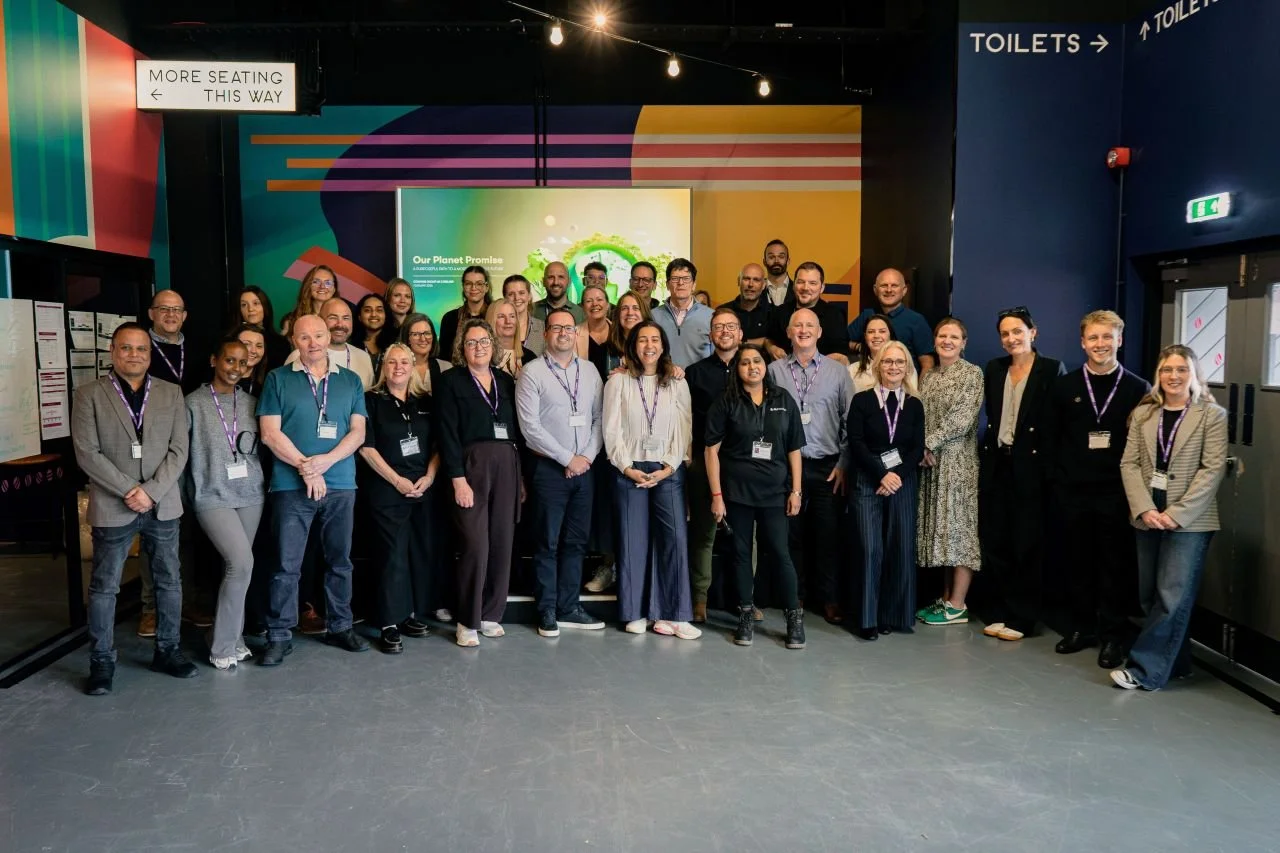
Accelerating Compass’ Transition (ACT) Sustainability Academy, a new learning initiative designed to develop the next generation of Sustainability Leaders. Colleagues came together with some of the programme's external advisors Kate Cawley, Future Food Movement, Veronica Moran (ANutr), Planeatry Alliance ; Hugh Jones, WRAP, Sophie Stephens, Foodsteps and Chantelle Nicholson, along with our internal SMEs - Scott Freeman, Nicky Martin RNutr and Ashleigh Taylor to listen, learn, discuss, debate and challenge.
I've found myself thinking a lot about confidence recently. Not because it was a topic I set out to explore, quite the opposite. It seems to have emerged accidentally from a series of conversations that on the face of it, had very little in common. Over the past few weeks I've spent time with investors discussing food system resilience and long-term value creation. I've sat with sustainability leaders trying to navigate shifting priorities inside large organisations and I've watched apprentices present ideas and challenge industry experts at Compass Group's ACT Academy.
On the surface, these conversations had very little in common. They involved different people, different pressures and different parts of the system. Yet I kept coming away with the same feeling - not that people lacked knowledge, if anything the opposite.
The food industry has never been better informed. We know more about climate risk, health, nature, supply chain resilience and geopolitical pressures than at any point I can remember. Every week brings another report, another forecast and another prediction about what comes next. There is no shortage of insight and yet for all that information, there is often a surprising amount of hesitation.
The investor discussion was probably where I noticed it most clearly. Nobody was debating whether resilience matters. Nobody was questioning whether climate exposure, food security or health are becoming material business issues. The conversation had moved well beyond that. Instead, the discussion centred on action. How much evidence is enough before an investment is justified? At what point does waiting for greater certainty become a risk in itself? How should businesses respond when the consequences may not be fully visible for years, but the signals are already clear enough to suggest change is coming?
The more I listened, the more I realised these weren't really questions about data. They were questions about judgement. And listening to the discussion, I found myself wondering whether confidence has quietly become an economic asset in its own right. Not confidence in the sense of optimism or certainty. Confidence to allocate capital, back innovation, attract talent and make decisions before every variable is known. The more uncertain the environment becomes, the more valuable that kind of confidence appears to be. And they're not confined to investors.
Many of the sustainability leaders I speak to can see the direction of travel. Commercial leaders can too. Boards understand the pressures building around them. The challenge is rarely understanding what is happening around them. The challenge is deciding what to do about it. That feels important because uncertainty has become such a defining feature of modern leadership. We're asking people to make bigger decisions with less certainty than ever before, whilst the consequences of getting those decisions wrong can feel increasingly visible.
What I've found interesting, though, is where confidence seems to come from.
Watching the apprentices at ACT Academy, it wasn't new information that changed the quality of the conversation over the course of the day. It was the opportunity to test ideas, challenge assumptions and realise that even the experts were still figuring things out. By the afternoon, many of the people who had spent the morning wondering whether they belonged in the conversation were contributing with real conviction.
I've seen something similar happen in peer groups. Often the value isn't a new piece of insight. It's the realisation that other people are grappling with the same questions. That uncertainty is shared. That complexity is normal. Confidence seems to grow when people realise they are not navigating these challenges alone.
The more I think about it, the more I wonder whether confidence is something we've misunderstood. We tend to treat it as an individual characteristic, something people either have or they don't. Yet most of the examples I've seen recently suggest otherwise. Confidence is often built collectively. It grows through connection, challenge and perspective. It grows when people have the opportunity to test their thinking, hear different viewpoints and realise that nobody has all the answers.
What I've become less convinced about is whether confidence is simply a leadership issue, increasingly it feels like an industry issue.
We talk a great deal about capability, risk and resilience, yet many of the challenges we face require something else entirely. The willingness to invest when returns may be years away. The appetite to innovate when the outcome isn't guaranteed. The ability to collaborate on problems that no organisation can solve alone. The belief that food remains one of the most exciting sectors in which to build a career. I also wonder whether we've become so focused on understanding risk that we've spent less time thinking about what creates opportunity.
The food system is surrounded by conversations about climate risk, nature risk, health risk, supply chain risk and geopolitical risk. Those conversations matter and they should. Yet when I look at the organisations shaping the future of the industry, I rarely see them talking only about risk. They're talking about growth, new markets, new technologies, new partnerships and new ways of creating value. The future will be shaped by opportunity as much as it is shaped by risk.
Opportunity however, requires something that often feels in short supply. It requires organisations willing to invest when returns may be years away, willing to innovate when the outcome isn't guaranteed and willing to collaborate on challenges that no single organisation can solve alone. Above all, it requires a belief that a different future is possible.
Talent keeps bringing me back to this point.
Watching the apprentices at ACT Academy wasn't just a reminder of how confidence develops. It was a reminder that if we want the next generation to build careers in food and agriculture, we need to offer them something to believe in. We spend a lot of time talking to young people about the challenges facing the food system, we spend less time talking about the opportunity to solve them. People are drawn to sectors they believe have a future.
Looking across the food system today, I don't see a shortage of intelligence, ambition or ideas. If anything, I see the opposite. What I see is an industry wrestling with complexity whilst trying to make decisions that will shape the next decade.
Which leaves me wondering whether we've become so focused on understanding risk that we've forgotten what creates confidence. Because confidence isn't simply a leadership trait, increasingly, it feels like an economic asset. One that determines our willingness to invest, innovate, collaborate and attract the people who will shape the future of our industry.
And one that may matter more than we realise.

Continue the conversation
Field Notes isn't intended to provide definitive answers. It's a reflection of the conversations, tensions and emerging signals I'm seeing across the food system through our work with leaders in retail, manufacturing, foodservice, farming, investment and policy.
If something here challenged your thinking, sparked a different perspective or you're seeing similar signals from your part of the system, I'd love to hear from you.
Whether you'd simply like to continue the conversation, or you're interested in how Future Food Movement helps organisations build the leadership capability needed to navigate the future of food, feel free to get in touch.
Explore previous Field Notes
Every month I connect the dots across leadership conversations, emerging signals and developments shaping the future of food.
Field Notes from the System #1 – April 2026
Field Notes from the System #2 – May 2026
Field Notes from the System #4 – July 2026