
Field Notes #4: The conversations are converging. Is your organisation?
Kate Cawley
Founder, Future Food Movement
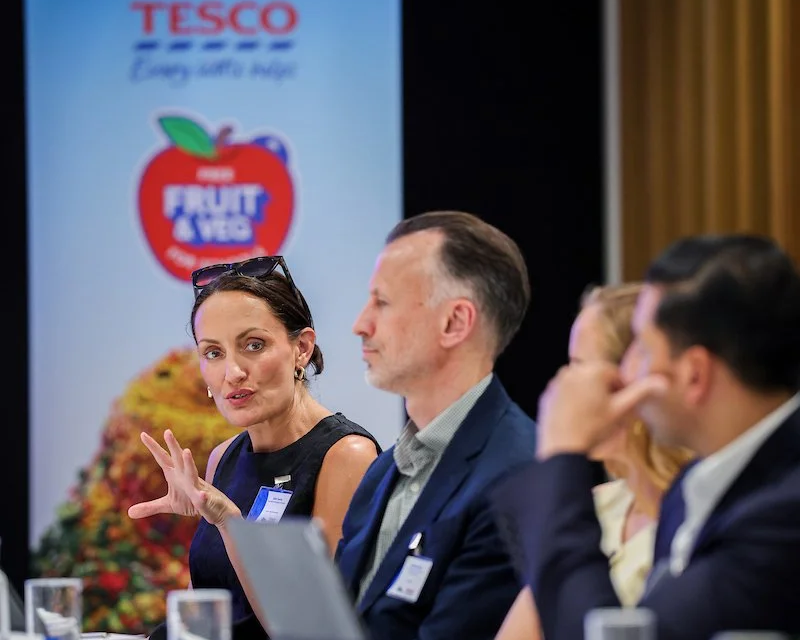
Tesco's health roundtable, hosted with The Guardian discussing how we better support children and families to eat more healthily.
I've rewritten this month's Field Notes more than any of the others and if I'm honest, that's usually a sign I'm circling something I haven't quite understood yet. I started off convinced I was writing about Groundswell. Then I became equally convinced it was really about Tesco's health roundtable with The Guardian. By Monday morning I'd decided it was about health.
It turns out it isn't really about any of those things. They're simply where something that's been quietly building over the last few months finally made sense.
One thing I've come to value about building Future Food Movement is the slightly unusual position it gives us. In the space of a few weeks we can find ourselves with investors, farmers, retailers, manufacturers, policymakers and executive teams, all looking at the future of food through completely different lenses. At the time those conversations often feel unrelated. Looking back, they're usually anything but. None of those conversations feels especially remarkable when you're in the middle of them, it's only when you step back that the patterns begin to emerge.
That's exactly what happened last week.
Groundswell was, as always, full of conversations about soils, biodiversity, resilience and the future of farming. I'd expected all of that. What I hadn't expected was how often those conversations naturally became conversations about health. Not health in the way our industry usually frames it, through obesity, regulation or HFSS, but through healthier soils, nutrient density, healthier food and businesses capable of producing that food for decades to come. Nobody was trying to make health the topic. It simply seemed impossible to talk about the future of farming without eventually talking about the health of the food being produced.
Forty-eight hours later I was sitting at Tesco's health roundtable. This time the discussion centred on children's diets, affordability, food environments, prevention and the role retailers can play in helping families make healthier choices. Again, it was thoughtful, ambitious and full of people who genuinely wanted to make progress. Then, somewhere on the train home one thought stopped me in my tracks. I'd spent two days listening to farmers talk about producing healthier food without hearing much discussion about public health policy. I'd then spent two hours discussing healthier diets without a farmer or grower in the room. Neither conversation was wrong and neither lacked ambition. Yet neither conversation could really succeed without the other.
That matters because children don't choose food systems, adults do. Farmers decide what is economically viable to grow. Manufacturers decide what they develop. Retailers decide what they stock and promote. Investors decide where capital flows and government shapes the rules of the game. By the time any of us walks into a supermarket, most of the important decisions have already been made. Which is why I've found myself wondering whether we've become too good at talking about individual parts of the system and not good enough at bringing the whole system together.
Once I'd noticed it, I started replaying the previous few weeks. Investors weren't really talking about climate anymore, they were trying to understand resilience and long-term value. Commercial leaders weren't asking whether health mattered, they were asking what changing consumer expectations might mean for innovation and growth. Our work with The Food Foundation wasn't really about policy in isolation, it was about whether policy ambition and commercial reality are being designed together rather than separately. Even Catalyst our nextgen leadership group, despite bringing together leaders from completely different functions, kept circling back to exactly the same challenge - How do you make good decisions when the answer no longer belongs to one team?
It made me realise I wasn't looking at lots of separate trends, I was looking at one shift appearing through lots of different conversations. For years we've organised ourselves around functions because that reflected the world we were operating in. Health sat in one part of the organisation, sustainability in another, commercial, innovation, procurement, finance and public affairs each had their own priorities and measures of success.
That wasn't wrong.
I'm just beginning to wonder whether the market has moved on more quickly than many of our organisations have. Health increasingly shapes innovation, innovation increasingly depends on resilient supply chains, resilience depends on farming, farming depends on commercial viability, commercial success increasingly depends on healthier products, trusted brands and long-term resilience. Each conversation begins somewhere different, yet increasingly, they all end up in the same place.
The conclusion I've arrived at is a simple one: the conversations are converging faster than organisations are.
That matters because organisational design shapes decision making. If we continue treating health, sustainability, resilience, food security and commercial growth as separate conversations long after the market has stopped making that distinction, we'll make slower decisions, miss opportunities and create unnecessary friction inside our own businesses. The competitive advantage won't simply come from having a stronger sustainability strategy or a better health strategy. It will come from recognising how these agendas are converging before competitors reorganise around them.
Which brings me back to capability.
I don't think the biggest gap I see across the industry is ambition. I've never known so many organisations genuinely wanting to move. The gap is that we're asking leaders to solve interconnected challenges through structures, reporting lines and career paths that were designed for a different era. The strategy is emerging faster than the capability to deliver it. That's why one question has followed me around since last week:
Who owns health in your business?
Five years ago that probably had a straightforward answer, today I'm not convinced it does. If health increasingly shapes innovation, portfolio strategy, resilience, food security, customer relevance and long-term growth, can it really belong to one function? Or are we asking the wrong question altogether?
If I were sitting around your Executive Team table, I'd ask everyone to write down the answer before anyone spoke. Not because I'm interested in who's right, I'm interested in whether everyone sees the organisation in the same way. My suspicion is they won't. And if they don't, don't worry about who's right. Pay attention to the conversation that follows because I suspect it will tell you more about your organisation's future readiness than another strategy presentation ever could.

Continue the conversation
Field Notes isn't intended to provide definitive answers. It's a reflection of the conversations, tensions and emerging signals I'm seeing across the food system through our work with leaders in retail, manufacturing, foodservice, farming, investment and policy.
If something here challenged your thinking, sparked a different perspective or you're seeing similar signals from your part of the system, I'd love to hear from you.
Whether you'd simply like to continue the conversation, or you're interested in how Future Food Movement helps organisations build the leadership capability needed to navigate the future of food, feel free to get in touch.
Explore previous Field Notes
Every month I connect the dots across leadership conversations, emerging signals and developments shaping the future of food.
Field Notes from the System #3 – June 2026