
The Scope 3 Accountability Gap
By Stephanie Lambert, Managing Director, Foodsteps & Helen Ireland, Strategy & Transformation Director, Future Food Movement
SBTi V2.0 has just raised the bar. Climate targets are no longer judged on ambition alone, they will increasingly be assessed on the credibility of the plan behind them and the evidence that progress is being delivered. For food businesses, where scope 3 emissions account for over 90% of their total footprint, that shift makes the foundations of accountability more urgent, and more consequential, than ever.
Food businesses are being held accountable for emissions they don’t directly control. That structural gap is where decarbonisation goes to die - unless you build the right foundations. And the right foundations have two parts: the data infrastructure to know where you stand, and the organisational capability to act on what it’s telling you.
Scope 3 is fundamentally a governance problem dressed up as a data problem. A retailer can set a bold 2030 target, but the farming practices, ingredient choices, and supply chain decisions that will determine whether they hit it sit with hundreds of suppliers across complex, fragmented value chains.
That’s the structural reality we see across the food system at Future Food Movement. And it’s the gap that too many organisations are still trying to paper over with reporting, rather than close with action.
Closing this gap requires two things working in sequence. First, the data foundations that make accountability possible — granular, ingredient-level, decision-grade. Second, the organisational capability to translate that data into decisions the whole business can move on. Without the first, you can’t prove progress. Without the second, the data sits unused.
In this piece, Stephanie Lambert, Managing Director of Foodsteps, addresses the data layer. We address the capability layer. Together, they represent the full picture of what it takes to move scope 3 from a reporting exercise into genuine delivery.
Part one: building foundations that scale
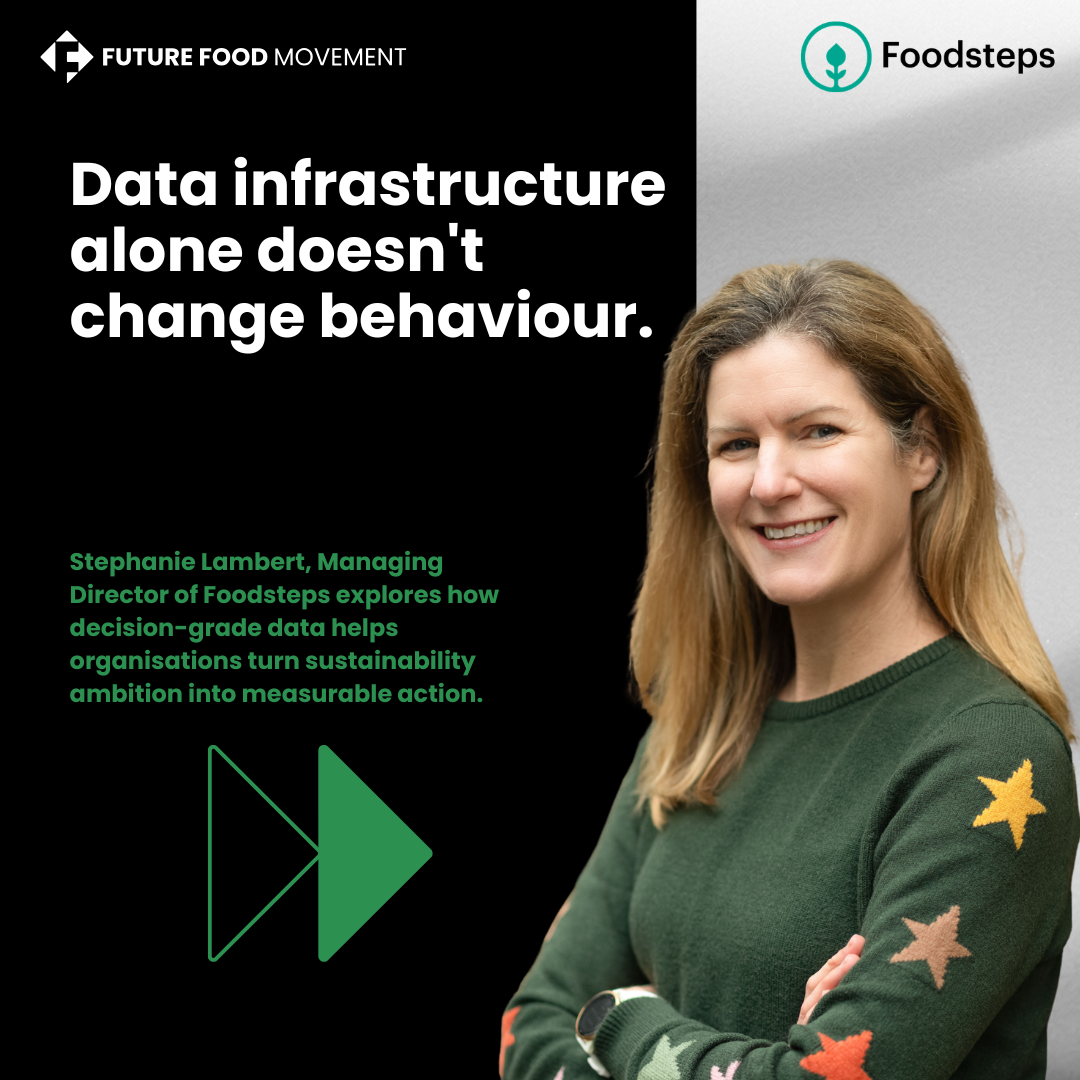
Stephanie Lambert, Managing Director, Foodsteps
At Foodsteps, we get to work with some of the most progressive food businesses in the UK, and what we see again and again is that the distance between a sustainability pilot and genuine enterprise-scale delivery is wider than most organisations expect.
The pilot that goes nowhere
Sustainability targets often break down in two predictable ways.
The first is by launching a pilot that was never designed to scale. A highly decentralised business that runs a pilot in one division quickly discovers that their group looks nothing like the rest of the company – different data, different processes, different decision-makers. The result is a collection of siloed experiments instead of a replicable model.
The second failure is more costly: skipping the foundational layer entirely in a rush to act. Businesses want momentum, understandably, but if the underlying data isn’t granular enough, they cannot prove that any real-world action has actually moved the needle. You’ve both invested. Your suppliers have changed practices. And you still can’t answer the question: so what?
What “foundational” actually means
When we talk about foundational data, we mean moving beyond industry averages and spend-based proxies. These metrics have their place as starting estimates, but they are not decision-grade.
If you’re running supplier programmes, joint decarbonisation initiatives, or reformulation work, you need ingredient-level data: country of origin, farming practice, the specific emissions profile of what you’re procuring. Without that, you cannot close the accountability loop. You cannot show your business the investment was worth it. And you cannot credibly demonstrate progress to customers, regulators, or investors.
This is what Foodsteps was built to solve. We have built a database of over 45,000 emissions factors across more than 4,800 ingredients, enabling businesses to move from approximate estimates to decision-grade scope 3 data, in days, not months.
The other gap: sustainability vs. the rest of the business
Data infrastructure alone doesn’t change behaviour. The structural gap in scope 3 isn’t just between a retailer and their supply chain - it’s between the sustainability team and everyone else.
Chefs don’t think in tonnes of CO₂ and procurement teams aren’t waking up thinking about emissions factors. R&D is focused on taste, cost, and shelf life. If you want sustainability to scale inside a business, you have to meet people where they are - with tools, goals, and language that actually make sense for them.
What works? Simple goal-setting, translated for each function in the business. Compass doesn’t ask chefs to reduce carbon - they ask them to get 60% of recipes to an A or B rating (colour-coded green and light-green respectively). Levy set a plant-based desserts target and hit 86%. The underlying ambition is the same. The language is completely different.
After the appropriate goals are in place, the tools must follow to empower teams to take action. They need to be simple enough for the person using them, not for the sustainability practitioner who designed them. If tools are too complex and not accessible to those who haven’t been in the sustainability space, they won’t get adopted at scale. And lastly, the companies we’ve seen progress fastest are intentional in building the cultural infrastructure alongside the technical layer: procurement playbooks, peer learning forums, and workshops where practitioners share what’s working. This is how things get truly embedded in organisations.
What’s making it stick
The businesses genuinely operationalising sustainability share one thing: they’ve connected sustainability to the incentive structures that already govern behaviour. When a C-suite bonus includes a food waste metric, food waste goes down. When procurement targets include sustainability components, procurement decisions change.
What gets measured gets done. What gets rewarded gets embedded. The scope 3 accountability gap only truly closes when the internal architecture of the business - its goals, its tools, its culture, and its incentives - is all pointing in the same direction.
Part two: turning data into decisions
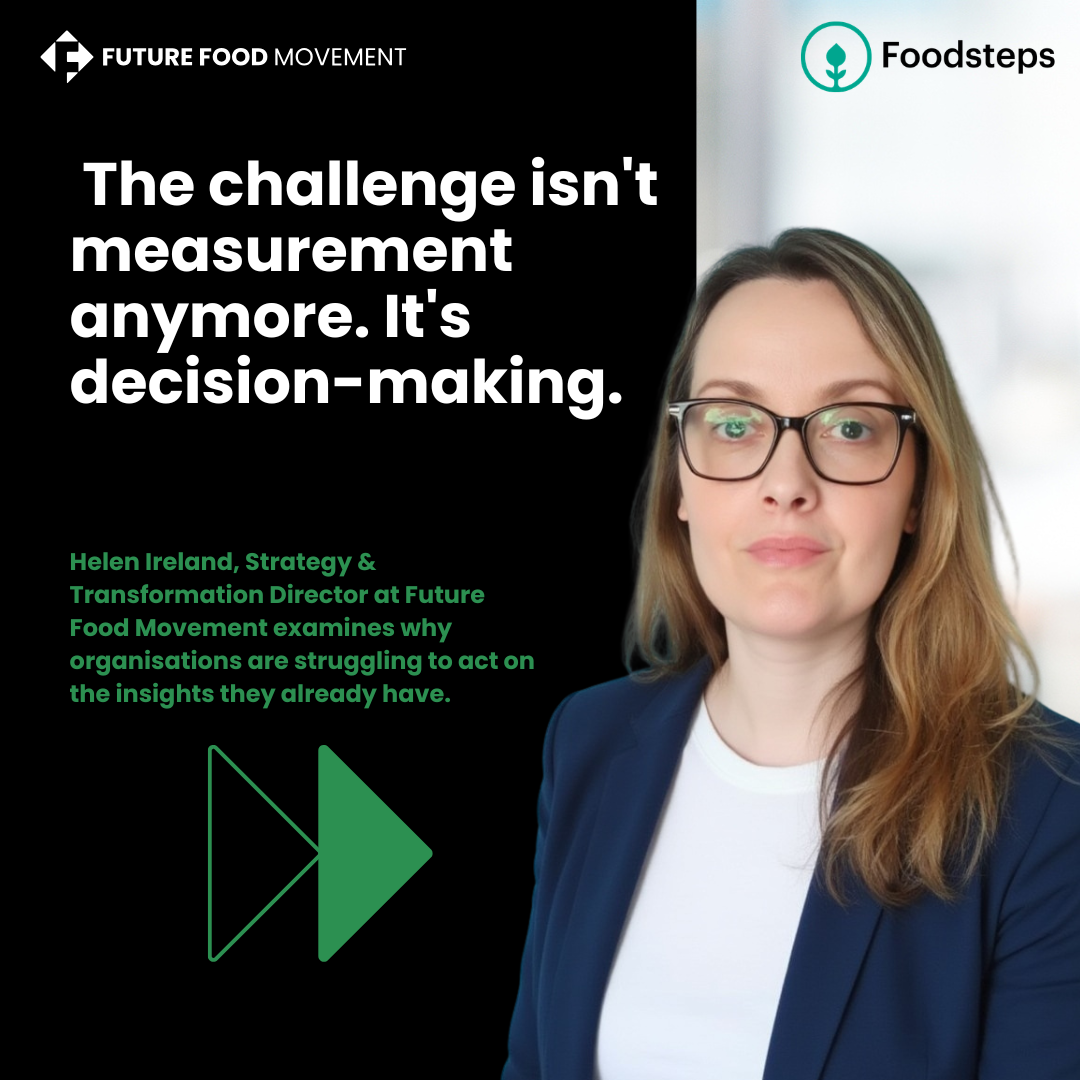
Helen Ireland, Strategy & Transformation Director, Future Food Movement
Getting the data right is the necessary first step. But in our experience working with food businesses, the harder challenge is what comes next: building the governance structures, the board-level confidence, and the cross-functional capability to actually act on what the data is telling you.
Everywhere we look, organisations have more data than ever but very little confidence around what to do with it. The challenge isn’t measurement anymore. It’s decision-making.
That challenge has just become more urgent. Under SBTi V2.0, businesses are expected to demonstrate not only what emissions reductions have been achieved, but the actions that delivered them and how those actions connect to their wider transition plans. Climate data is now expected to carry the same rigour as financial reporting. Organisations that have been measuring without acting - or acting without being able to prove it - are running out of road.
A more complex operating environment
Scope 3 doesn’t sit in isolation. Food businesses are now operating at the intersection of three converging pressures: health expectations reshaping what products succeed, carbon constraints reshaping cost, supply and claims, and supply risk exposing weaknesses in sourcing and strategy.
Individually, these are known challenges. Combined, they change how commercial decisions need to be made. Sourcing, pricing, product mix, positioning - these are now influenced simultaneously by health, carbon and risk. Yet most teams are still tracking them separately, with separate data, without a clear way to translate the combined picture into action.
The gap is not awareness. It’s decision-making under combined pressure.
Where organisations get stuck
Most sustainability strategies stall not because the data is wrong, but because the organisational conditions aren’t right. The insight layer - the ability to take decision-grade data and translate it into something a procurement director, a CFO, or a board can act on - is missing.
That means building three things in parallel: governance structures that give sustainability decisions the same rigour as financial ones; cross-functional alignment that connects sustainability targets to the incentives and language of each function; and board-level confidence grounded in commercial risk and opportunity, not just compliance.
The organisations making the most progress are those that have stopped treating scope 3 as a sustainability workstream and started treating it as a business transformation challenge. That reframe changes everything, who’s in the room, what questions get asked, and what actions follow.
What Future Food Movement does
The challenge is making the right commercial calls as pressures accelerate. Future Food Movement equips leaders with the capability, confidence and connection to act decisively, influence outcomes and stay ahead, turning pressure into advantage.
Most food businesses are facing the same brutal reality: the pressures hitting them right now - HFSS compliance, UPF scrutiny, producer viability, climate disruption, affordability - don’t sit in one team, one function or one part of the supply chain. But organisations are still structured as if they do. The result is leaders making consequential decisions with incomplete visibility, commercial teams disconnected from supply realities, and sustainability agendas that never quite land as business strategy.
The cost isn’t just slow progress - it’s execution risk that amplifies every other risk on the board.
Future Food Movement exists because that problem cannot be solved from inside any single organisation. By connecting leaders across the entire food value chain - retail, manufacturing, farming, health, finance and policy, Future Food Movement gives members the cross-system visibility, peer intelligence and leadership capability they cannot build alone. Not to understand the future better. To deliver through it now.
Ready to close the gap?
The scope 3 accountability gap is real. But it’s closeable - when you build in the right order.
If you need decision-grade ingredient-level scope 3 data, Foodsteps can get you there in days, not months.
Visit foodsteps.earth or email hello@foodsteps.earth
If your challenge is turning scope 3 data into decisions the whole business can act on, Future Food Movement can help you build that capability. Get in touch about:
Climate Transition & Scope 3 Strategy - Email Helen (link to Helen.Ireland@futurefoodmovement.com
Decarbonisation Accelerator Programmes - Email Helen (link to Helen.Ireland@futurefoodmovement.com
Food Systems Essentials Accelerator - open to anyone in food and drink, from £540pp hello@futurefoodmovement.com