
The basket won’t change. The food inside it has to.
As a new Future Food Movement member, UPP is focused on a practical question facing food producers now: how do you improve nutrition, reduce impact and protect affordability without asking shoppers to change what they buy?
In this piece, Mark Evans, CEO of UPP argues that the answer sits upstream, in reformulating the everyday products people already know and trust.
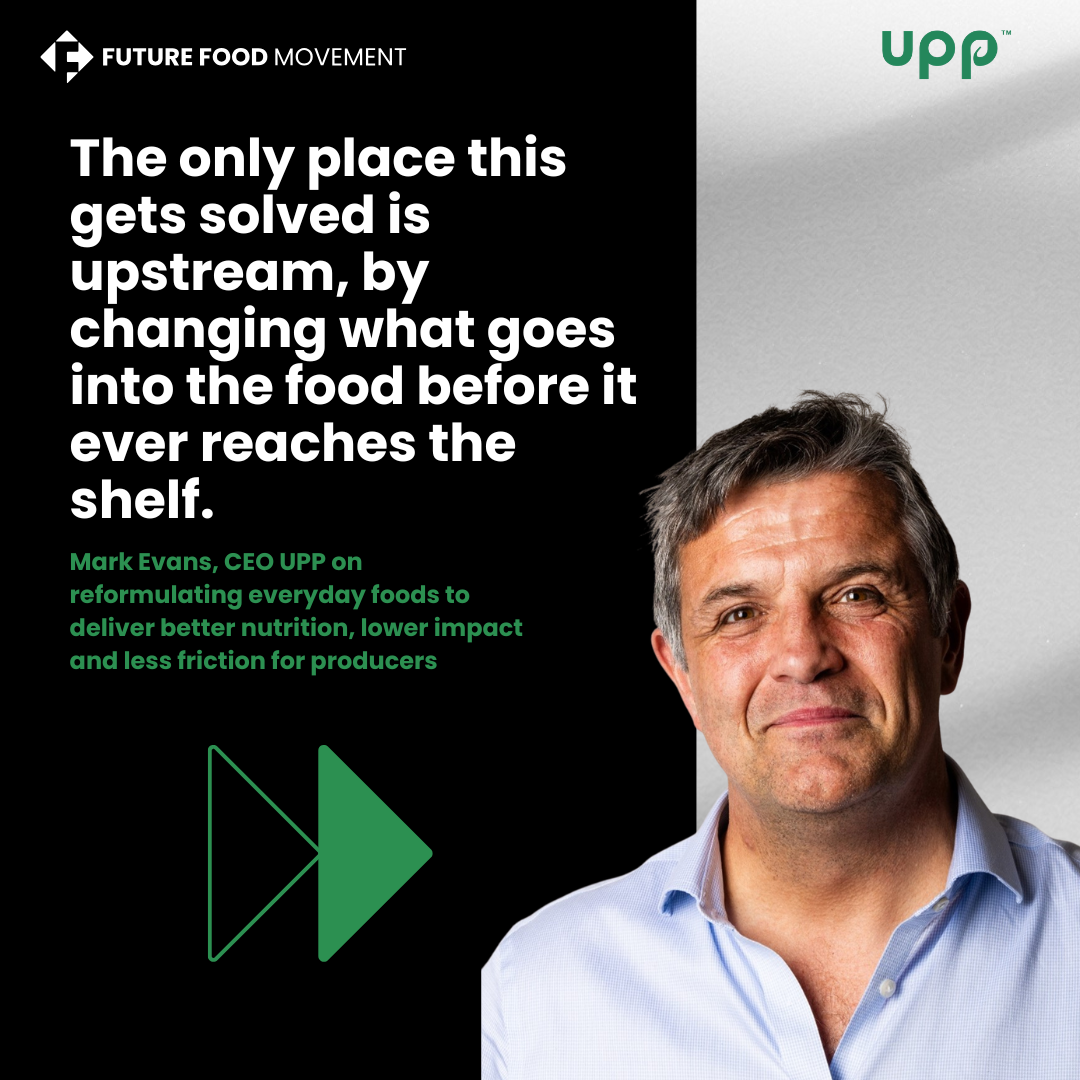
By Mark Evans, CEO, UPP
“There is a hope, quietly held across a lot of food businesses, that the next phase of healthier eating will be led by the shopper. That people will trade up, read the label, accept a slightly different texture, pay a little more, and reward the companies that got there first.
The evidence doesn’t support the hope.
Decades of public health effort tell us something uncomfortable but clear: people will not reliably change what they eat even to protect their own health. If that lever were strong, the fibre gap would already be closed - and in the UK, only around 4% of adults hit the 30g daily recommendation. Food decisions don’t sit inside good intentions. They sit inside time, budget, habit, and the simple, non-negotiable expectation that dinner tastes like dinner.
So, the question every food producer is now holding isn’t how do we persuade people to choose better? It’s harder than that, and it has two halves that pull in opposite directions.
Two pressures, arriving at once
The first pressure is cost. Food inflation hasn’t gone away as a structural force, input volatility is now the baseline rather than the exception, and the shelf-edge responses that absorbed a decade of margin pressure - smaller portions, cheaper inputs, more filler - have run out of room. There is no slack left in the recipe to cut.
The second pressure is nutrition, and it has a new shape. GLP-1 medications are changing the basket in real time - not in theory, but in portions, in protein choices, in what a meal is now being asked to do. When people eat less, every mouthful has to carry more. The next phase of food isn’t about eating less. It’s about more nutrition per bite. An ageing population, a fibre-deficient one, and a fast-growing cohort of medication users all point the same way: density matters more than volume, and it matters now.
Here is the trap. Most strategies treat these as a trade-off. Improve nutrition or manage cost. Reformulate or protect the eating experience. Pick one and accept the loss on the other.
That framing is the problem. The two needs must be met concurrently, because the consumer who won’t change their basket also won’t accept a worse product or a higher price to make a producer’s sustainability maths work. The only place this gets solved is upstream - not at the shelf, not at the till, but in what goes into the food before it ever reaches either.
Low-friction is the whole game
Reformulation rarely fails for lack of ambition. It fails because of friction: process disruption, allergen complexity, supply that can’t commit, sensory risk, approval cycles, and a procurement team whose job - rightly - is to keep the line running, not to take a punt. Every one of those frictions is a reason to revert to a marginal tweak instead of a real improvement.
Which means the ingredient innovations that actually scale aren’t the most novel ones. They’re the ones engineered to lower the cost of saying yes. Drop-in. Non-novel, so there’s no regulatory queue. Allergen-clean, so it doesn’t add complexity. Cost-stable and regionally anchored, so it survives volatility. And - the part that decides everything - invisible on the plate.
This is the space UPP works in. www.upp.farm takes under-utilised brassica biomass - the broccoli stem, stalk and leaf that mostly never enters the food system today - and convert it, through mechanical and physical processing, into food-grade protein and fibre ingredients designed to slot into existing manufacturing at inclusion rates that hold taste, texture and price. The crop is already grown. The nutrition is already there. What’s been missing is the infrastructure to put it to work inside the products people already buy.
What that looks like in a real product
A traditional cottage pie — a staple of the UK’s multi-billion-pound ready meal market - is a useful test, because it’s exactly the kind of everyday, price-sensitive, format-locked product where reformulation usually stalls.
In a recent UPP trial, broccoli fibre replaced a portion of the beef (mince from 34% down to 24%, with 10% fermented brassica fibre stepping in), and a dried fermented brassica binder replaced conventional flour. The format, the cooking process and the serving experience stayed the same. On the modelled figures, per 100g: fibre up 125% - enough to support a “source of fibre” claim the original couldn’t make - alongside fewer calories, less fat and less saturated fat, and gluten removed entirely from the recipe, simplifying allergen management across the line.
The part that matters most for whether any of these scales: in sensory evaluation, the upgraded pie held its ground. Creamy mash, a firm savoury filling, no broccoli notes coming through. No repositioning, no premium, no consumer friction.
The caveat is that those nutritional figures are calculated via NutriCalc and not yet lab-verified, and the next step is consumer sensory testing and larger-scale trials before commercial activation. The direction, though, is the point - better nutrition, lower cost pressure, a cleaner label, and a product the shopper doesn’t have to think about.
The sustainability dividend is a by-product, not the pitch
There’s a final piece, and the order matters. Because these ingredients come from biomass that already exists - the land, water and fertiliser already spent growing the broccoli head - they carry a fraction of the embedded footprint of a dedicated protein crop grown and shipped for the purpose. An independent interim life-cycle analysis puts the ingredient below 0.25 kg CO₂e/kg. When a domestic, side-stream-derived ingredient displaces an imported one, the Scope 3 reduction is tied to operational change rather than offset after the fact.
But sustainability isn’t the reason a manufacturer says yes. It’s what they get for free when they say yes to something that was already cheaper, more nutritious and lower-risk. That’s the only version of sustainability that scales: the kind that arrives as a consequence of doing the job better, not as a premium someone has to choose to pay.
The work is upstream
The shopper isn’t going to fix the food system by buying differently. That’s not a failure of will - it’s how everyday food works and building a strategy on the opposite assumption is building on sand. The producers who navigate the next decade well will be the ones who stop waiting for behaviour change and start changing the inputs: meeting the cost pressure and the nutrition demand at the same time, inside the products people already trust, without asking anyone to notice. Quietly. Upstream. At scale.
Better for producers. Better for people. Better for the planet - by design, not by sacrifice.”
For UPP, better food at scale means making existing products work harder: more nutritious, lower impact and commercially realistic, without adding friction for producers or compromise for shoppers.
As UPP joins the Future Food Movement network, they are keen to connect with members exploring how reformulation can support healthier, more sustainable products in practice.
Get in touch with UPP hello@upp.farm or visit their website to find out more.