
Meet a coach: Susan Thomas
“We’ll be fine” is exactly what BlackBerry said. Why decarbonisation and health aren’t a separate agenda, they’re the commercial leader’s actual job
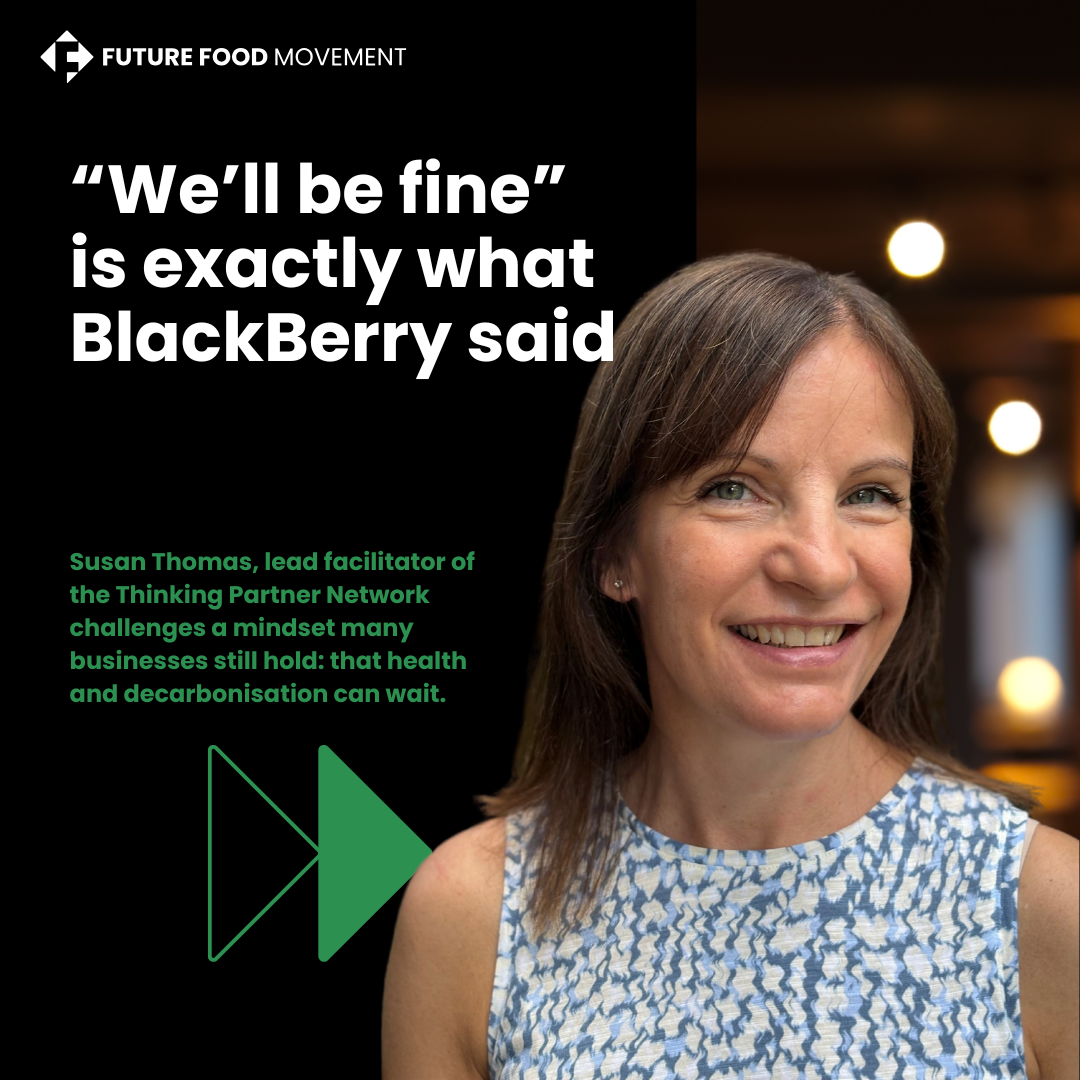
In the year 2000, the Daily Mail ran a headline declaring the internet a passing fad. In 2007, the CEO of Microsoft was confident the iPhone had no chance of meaningful market share. The leadership of BlackBerry, watching the same launch, reassured everyone: we’re okay, we’ll be fine.
This is the story Susan Thomas, former Senior Director of Sustainability at Asda, eight years at PepsiCo before that, and one of Future Food Movement’s Expert Coaches opened with at a recent Expert Event on commercial leadership. Her point was pointed: any leader today saying “we’ll be fine” is probably looking at the same future as BlackBerry. The question isn’t whether health and climate will reshape the food system. The question is whether leaders are building the capability, influence and judgement required to respond before competitors do.
It’s a useful frame, because it reframes the whole conversation. Acting on decarbonisation and health, Susan argues, is not some lofty, ethical, do the right thing add on to the day job. It is the day job. These are now commercial, operational and strategic leadership issues.
It’s what leadership has always meant; lifting your head above the relentless pressure of solving today’s problems with today’s products and systems, and forming a clear judgement on what it will take to win in three, five and ten years’ time.
“If there is anybody left who thinks that is not going to involve action on climate and on diets in particular, then they’re living under a rock. Those things are inevitable. They are coming.”
Nobody in the room seemed to disagree with that assessment. The challenge wasn't understanding the destination. It was how to lead organisations there when cost, risk, growth and day-to-day realities are pulling in different directions.
Reframe the ask
A lot of well-intentioned sustainability conversations fail before they start because of how they’re framed. Too often we make the job sound overwhelmingly large, abstract and several pay grades above the person we’re talking to. I’m the buyer of Christmas biscuits, and you want me to overhaul the food system?
Susan’s challenge to all of us is to stop asking for system reinvention and start asking for things that sit squarely within a person’s gift. The same biscuit buyer can’t fix the food system, but they can answer a very concrete set of questions: Do you know the key environmental impacts across your range? Do they differ by product? What are your suppliers doing about their cocoa supply, and how exposed are your numbers to the inflation that comes when that supply gets tight? Which of your suppliers is most proactively managing those risks and therefore most likely to protect your availability and shield you from future regulatory restrictions on high carbon products?
That isn’t a revolution. Some will feel it’s nowhere near ambitious enough. But it is meaningful change that can happen today, delivered by one person without an entire system reconfiguration. It’s also the logic behind the PepsiCo healthier snacking story, shifting a whole category ahead of HFSS regulation, one commercially sensible decision at a time.
The same holds for decarbonisation and for health. As Susan put it: you don’t need everyone suddenly eating carrots. If Crisp Brand A has a better health score or a lower carbon footprint than Crisp Brand B, simply leaning the range towards A shifts the overall profile of the category, and the national impact, with no capital re engineering at all.
One more thing on framing: bring data. “In God we trust,” as the saying goes, “everyone else brings data.” And bring good data, not the tired line that 85% of consumers want to buy greener products, because we all know they don’t act on it.
Meet people where they actually are
Reframing only works if you understand the person across the table. Buyers right now are under immense, relentless pressure on price it’s all the newspapers and the government seem to care about, and food inflation has turned what used to be genuine supplier partnerships into something transactional and, in Susan’s words, joyless. A generation of commercial people who started their careers in a Covid world have been locked in a daily battle to be cheaper than Aldi, and have never really had the chance to build the strategic category development muscles their predecessors took for granted.
So don’t assume they know why they should care about your agenda, or that they understand your acronyms. And don't assume a stronger technical argument will win them over. Do assume they may be wary of what you want, nervous they’ll look stupid, and quietly terrified you’re about to add to their workload. Show, first and foremost, that you’re on their side.
This is what Susan means when she describes her time at Asda: “I did not do sustainability TO my colleagues. I sought to understand what they needed their sustainability team to help them get done.” It’s why the much watched Asda refill trial moved forward at all, not because it washed its face financially (it didn’t), but because people got their pictures in The Grocer, the exec team came to visit, and suppliers were excited to lean in with exclusives and promotional funding. You find the motivation that’s real for each person, and you build from there.
The hard part isn’t knowing the right thing
Which brings us to the real difficulty. As one attendee asked Susan directly: how do you keep a commercial leader’s confidence to commit to something whose benefits are three to five years out, when the pressure is all on today?
There’s no neat answer, if there were, we’d all be doing it. But the work, Susan suggests, is relationship deep: leaning in, investing the time to build shared understanding, and being honest about risk and timeline together. The hardest part of leadership today is rarely knowing what the right thing is. It’s navigating competing pressures, influencing across the organisation, building alignment, and holding commercial credibility while making decisions where there are no perfect answers.
That is precisely the gap our Thinking Partner Network exists to close. It’s a professionally facilitated, cross-industry peer network for current and emerging sustainability leaders who need more than technical expertise to drive change inside complex organisations. A trusted space to pressure test decisions, sharpen influence and turn ambition into credible commercial action. Susan Thomas is one of its lead facilitators, and the network brings together senior leaders from retail, manufacturing, farming, finance and beyond to work through exactly the tensions this article describes.
The programme that kicks off the next Thinking Partner Network cohort runs from September to November 2026. If “we’ll be fine” no longer feels like a strategy, register your interest today and start getting you and your business ready to win in a future where the rules of winning are different.