
Field Notes #2. Farmers are ready. The question is whether the system is ready to move with them.
Kate Cawley
Founder, Future Food Movement
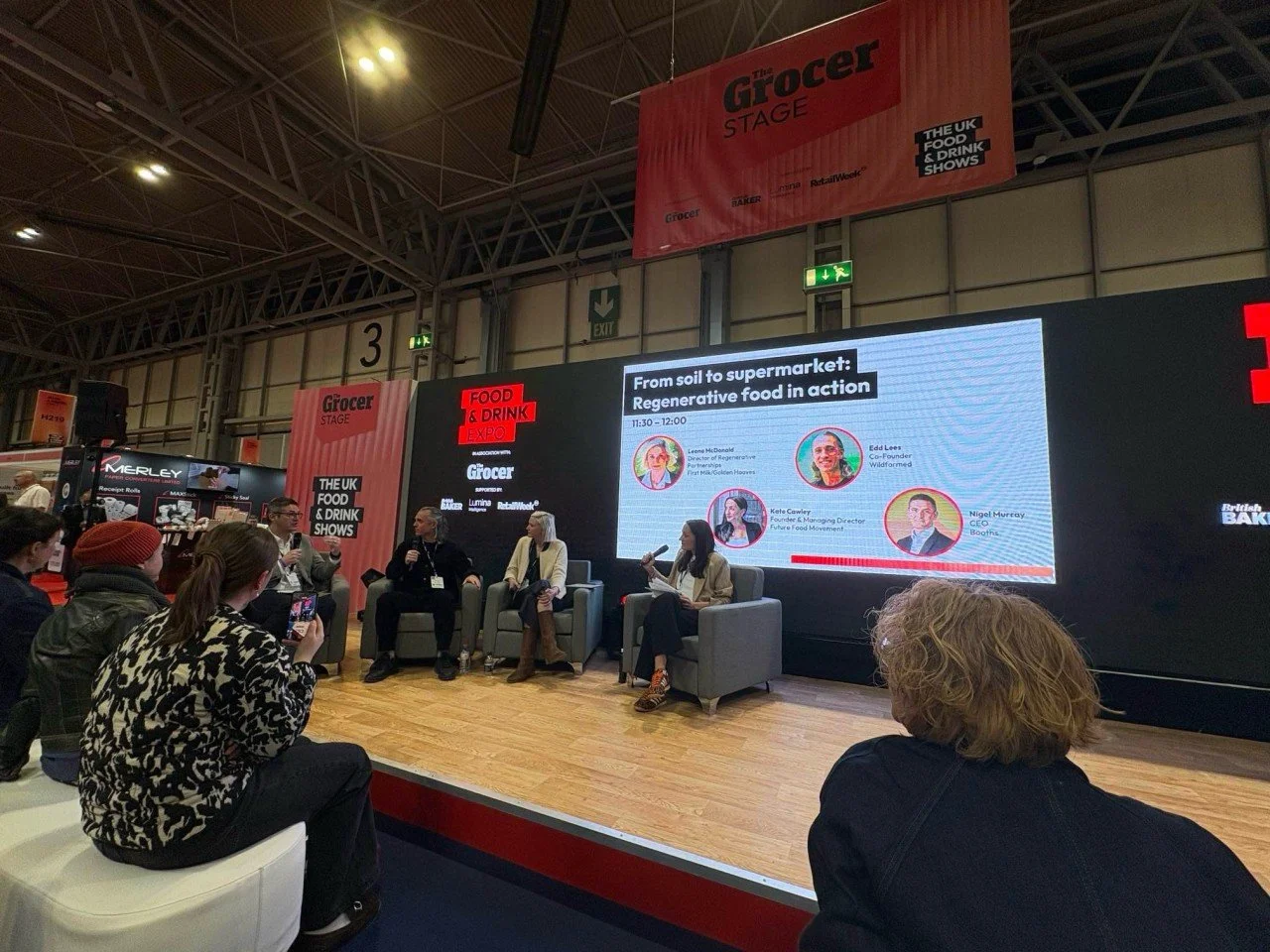
Joining me at The Grocer stage: Leona McDonald, First Milk, Edd Lees, Wildfarmed and Nigel Murray, Booths
I’ve been in a run of very different conversations over the past couple of weeks and I’ve been trying to make sense of what connects them.
Emma chaired our recent four proteins discussion, I was on stage at The Grocer Live Food & Drink Expo hosting a panel on regenerative agriculture with some incredible leaders (the real deal), we brought together a NextGen C-suite roundtable with Redgrave looking at how future leaders are being asked to lead under very different conditions and in the background there’s been a steady stream of conversations with sustainability leaders who are trying to hold all of this inside their organisations right now. On top of that, we’re about to bring a group of senior leaders together again for our Leaders’ Briefing on 28th April with voices like Anya Doherty, Emily Norton, Fiona Graham, Nigel Murray and Richard Crampton, all navigating these trade-offs in real time.
Different rooms, different lenses, but the same underlying tension keeps showing up and I don’t think it’s being talked about plainly enough.
On paper it feels like the system should be moving faster than it is. There is no shortage of solutions and there hasn’t been for a while now. Regenerative agriculture has moved well beyond theory into practice, protein innovation is no longer niche, health is increasingly being pulled into core commercial strategy rather than sitting on the sidelines and most large businesses now have some form of net zero roadmap in place that is far more developed than even two or three years ago. None of this feels marginal anymore. It is embedded, discussed, funded, tracked.
And yet when you look at what is actually scaling at pace, it still feels slower, more fragile and more contested than it should. Not stalled, but not flowing either.
What has become clearer to me, sitting across these conversations, is that this isn’t really a problem of ambition or even capability in the way we often frame it. It is a problem of alignment. That word can sound a bit abstract, but in practice it shows up in very tangible ways when you listen closely to how different parts of the system are making decisions.
In the protein discussion, there wasn’t a lack of intent or even disagreement about direction. What came through was how differently risk, reward and time horizons are experienced depending on where you sit. Farmers are making calls based on viability and confidence, often without clarity on how changes will be valued or paid back. Retailers are balancing margin, availability and customer expectation under constant scrutiny, which makes experimentation harder than it might look from the outside. Brands are trying to translate complex shifts into something that lands with consumers without losing commercial traction and foodservice operators are working within operational constraints that rarely get factored into wider system conversations.
At the regenerative panel, the tone was slightly different but the tension underneath was the same. There was a lot of honesty about the imbalance of risk and reward, about the fact that we often ask for change in one part of the system without really shifting the conditions around it, and about how difficult it is to scale something that relies on long-term thinking in a system that is still largely wired for short-term decision making. One comment from that discussion has stayed with me because of how simply it captured the issue: farmers are ready, the question is whether the system is ready to move with them.
I keep coming back to that because it extends far beyond regenerative agriculture.
It applies to health, where we say it is becoming a core commercial driver, yet incentives and metrics are still catching up. It applies to climate, where targets are set but the pathways to deliver them often sit in tension with immediate commercial realities. It applies to protein, where better options exist but struggle to scale because the system still rewards low-cost, short-term solutions more consistently than long-term resilience.
What makes this particularly complex right now is the wider context these decisions are being made in - the macro environment is not neutral. Ongoing geopolitical instability, pressure on global supply chains, input cost volatility and a renewed focus on food security are all shaping how leaders think about risk. In that context, the instinct to prioritise certainty, cost control and availability is not irrational, it is entirely understandable. But it does make the alignment challenge harder, because the very conditions that make transformation more urgent are also the ones that make it more difficult to act.
The Next Gen roundtable added another layer to this, because it brought in the perspective of future leaders who are being asked to operate inside this tension from the outset. What came through strongly there was not a lack of ambition, but a very real awareness of the trade-offs they are inheriting. There was a sense that the brief they are being given is fundamentally different, that they are expected to deliver on purpose and performance simultaneously, but without the system always being set up to support that. It raised a question that I think we will hear more of over the next few years, which is not just how do we fix the system, but how do we make it possible to lead within it.
And that is probably where this lands most heavily in my conversations with sustainability leaders at the moment. There is a weight to those roles that feels more pronounced than it did even a year ago. Many of them are clear on what needs to happen. The challenge is not a lack of ideas, it is how to navigate organisations, incentives and decision-making structures that are not always aligned with those outcomes. The tension is less about vision and more about execution in the real world.
Which brings me to the Leaders’ Briefing on the 28th.
What feels important about that moment is not just the content, but the mix of voices in the room. When you have leaders from retail, farming, policy, finance, technology and family business all sitting together, there is an opportunity to move beyond surface-level agreement and get into how these decisions are actually being made, and where they are getting stuck. The value of those conversations, when they work well, is not that they produce neat answers, but that they create a more honest understanding of the constraints each part of the system is operating within.
Because until that understanding is there, alignment is very difficult to achieve.
I’ve found myself thinking less about what the next solution is, and more about what needs to change in how decisions are made and rewarded if the solutions we already have are going to scale. How risk is shared more evenly across the system, how longer-term outcomes are valued in short-term environments and how leaders are supported to hold that tension without defaulting back to what feels safest.
None of that is simple, and none of it will be solved in a single room or a single conversation. But it does feel like the next phase of this work, not more ideas but better alignment around the ones that already exist.
I’m interested in whether others are feeling that same shift. If farmers are ready to move, what's holding the rest of the system back, and is your organisation part of the answer or part of the friction?"

Continue the conversation
Field Notes isn't intended to provide definitive answers. It's a reflection of the conversations, tensions and emerging signals I'm seeing across the food system through our work with leaders in retail, manufacturing, foodservice, farming, investment and policy.
If something here challenged your thinking, sparked a different perspective or you're seeing similar signals from your part of the system, I'd love to hear from you.
Whether you'd simply like to continue the conversation, or you're interested in how Future Food Movement helps organisations build the leadership capability needed to navigate the future of food, feel free to get in touch.
Explore previous Field Notes
Every month I connect the dots across leadership conversations, emerging signals and developments shaping the future of food.
Field Notes from the System #1 – April 2026