
Farming Roadmap 2050: ambition is welcome, but delivery has to work on farm
The Government's new Farming Roadmap gives the sector a longer-term direction. Farmers in Future Food Movement's Farmer-Led Working Group welcome parts of that direction, but they are clear about the gap that still needs closing: how will this translate into viable farm businesses, fairer risk-sharing and better commercial decisions across the food system?
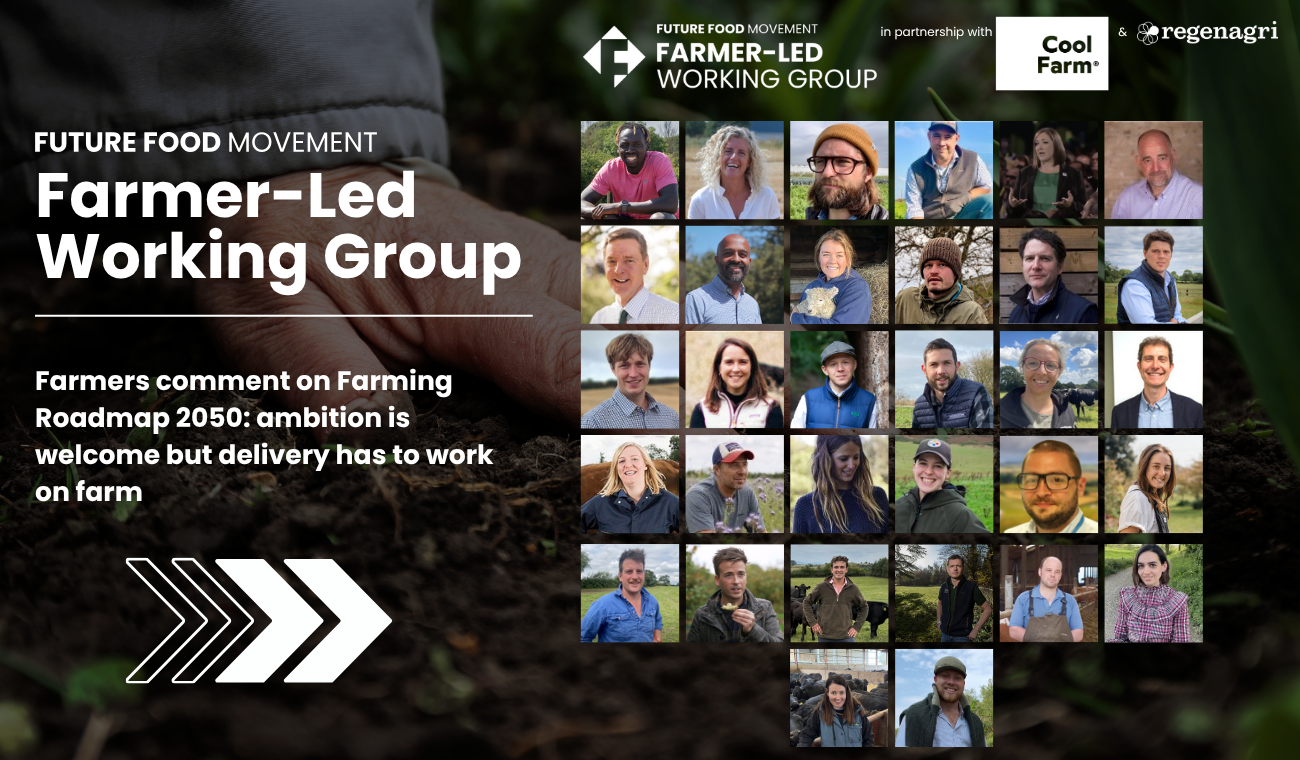
The roadmap lands at a time when farmers are already making decisions under pressure. Costs remain volatile. Climate risk is affecting production. Labour, skills and business capacity are stretched. Supply chain signals are often unclear or short-term, while expectations on farm continue to grow.
For Future Food Movement members, this matters because the roadmap is more than a farming policy document. It is a signal about the future operating context for food businesses. It sets a long-term direction for English farming through to 2050, with a focus on profitability, productivity, sustainability and resilience.
That direction is welcome. The question now is whether it gives farmers enough confidence to invest, adapt and build businesses that can keep producing food while also meeting climate, nature and resilience goals.
As Chris Manley, a member of Future Food Movement's Farmer-Led Working Group, put it:
"The ambition is clear. The delivery is less so."
That sentence gets to the heart of the issue. Farmers are not rejecting the direction of travel. Many recognise the need for a farming future that improves soils, protects water, supports biodiversity and builds resilience into food production.
But farmers are asking how the transition will be paid for, who carries the risk and whether the wider system is ready to change with them.
What farmers welcome: longer-term direction
One of the strongest positives in the roadmap is the shift towards longer-term clarity. Farming decisions rarely work on neat annual cycles. Arable rotations, livestock breeding, machinery investment, soil improvement and infrastructure planning can play out over many years.
Jon Myhill, speaking from an arable perspective, welcomed that longer horizon:
"The long-term direction is welcome. Arable decisions on rotations, machinery and soil investment play out over years, not seasons, so a plan running to 2050 beats policy that shifts with every budget. The test will be whether the detail follows the ambition."
That point matters for food businesses too. A farmer cannot invest confidently in soil health, lower-input systems or new technology if the commercial return is unclear, the policy mechanism keeps changing or the supply chain only offers short-term buying commitments.
This has been a consistent theme across the Farmer-Led Working Group. Farmers have described resilience as something built through viable businesses, confident decision-making and the ability to invest through uncertainty, rather than through ambition alone.
The roadmap recognises the need for profitable farms, fair rewards, domestic food production, good jobs and a sector that contributes to climate and nature goals. Farmers broadly support that direction. The harder question is how those aims sit together when margins are already tight.
One farmer in the group put the commercial tension plainly: farmers trade in a global economy, and doing the right thing is harder when the business is losing money. When margins are under pressure, values alone cannot carry the cost of transition.
If the roadmap raises expectations on farm without changing the commercial conditions around farming, the risk is that the cost of transition simply moves further down the chain.
What needs care: soil ambition must reflect farm context
The roadmap's focus on soils is a strong signal. Government has set out an ambition to bring 60% of England's farmland into sustainable soil management by 2030. For farmers, this is not a side issue. Soil condition shapes yield, resilience, water management, input dependency and long-term business viability.
Jon Myhill welcomed the focus, while also warning against blanket assumptions:
"Soils being front and centre is the right call. Bringing 60% of England's farmland into sustainable soil management by 2030 is a big ask, and maize will be under the spotlight given its reputation on erosion and late harvests. Grown well, with earlier varieties, cover crops and sensible field selection, maize sits comfortably in that picture. It needs judging on how it's grown rather than the crop itself."
This is where policy and supply chain standards need to be careful. If the focus becomes a simple judgement against particular crops or practices, the system risks missing the more useful question: what is happening in the field, under what conditions, and with what management?
The roadmap's move towards better field-level soil data could help. Used well, it can support more accurate decisions and avoid broad-brush assumptions. Used poorly, it could become another reporting burden that gives farmers little value back.
That has been a repeated message from Future Food Movement's Farmer-Led Working Group. Farmers are already asked for data, evidence and assurance, but they do not always see how that information changes buying decisions, improves value-sharing or strengthens long-term partnerships.
For members, the implication is clear. Soil data, carbon data and sustainability reporting need to be connected to commercial decision-making. If farmers are asked to prove improvement, the system around them needs to reward it in ways that are visible and credible.
What is missing: delivery capacity and resource
Several farmers saw positives in the roadmap. There is welcome recognition of farming's contribution to the broader economy, the need for skills and efficiency, regenerative agriculture, circularity, supply chain fairness and systems-level thinking.
But there is concern that the document recognises many of the right issues without yet showing how they will be delivered in practice.
As Chris Manley said:
"More expectations, but where is the resource? Farmers are expected to deliver food security, biodiversity, climate resilience and water quality simultaneously, with ongoing pressure on labour and business capacity."
That is a practical issue, not just a policy critique. Transition takes time, people, coordination and advice. It requires project management on farm and across supply chains. It requires someone to connect finance, technical advice, buyer requirements, environmental outcomes and commercial reality.
The limiting factor is often not farmer willingness. It is misalignment between expectations, incentives and capacity. Farms are making high-cost, long-lead decisions with partial or delayed information, while climate, commercial and production timelines increasingly collide.
For food businesses, support cannot stop at setting targets or asking suppliers to comply. If businesses want resilient sourcing, lower-impact production and credible progress against climate and nature goals, they need to understand what delivery looks like on farm.
What food businesses need to watch: risk is still landing on farm
The roadmap talks about government shaping markets, crowding in private investment and supporting food security, profitability and public goods. That matters, because farmers cannot carry the transition alone.
Across Future Food Movement's Farmer-Led Working Group, farmers have repeatedly described a system where risk is concentrated at farm level while decision-making power often sits elsewhere. Commercial teams, retailers, manufacturers, processors, government and finance all shape the conditions farmers operate within. But when costs rise, schemes change, weather hits or markets move, farms often carry the immediate impact.
Jon Myhill highlighted one part of the roadmap that arable growers should watch carefully:
"The bit arable growers should read twice is the principle that practices paid for today through ELM become standard practice, and eventually regulation, tomorrow. That's a cost quietly shifting from taxpayer to farmer at a time when arable margins don't have much give in them."
That is an important commercial point. If today's funded environmental practices become tomorrow's baseline requirement, food businesses need to understand what that does to cost structures. If those costs are absorbed solely by farms, the system may appear to be progressing while quietly weakening the businesses it depends on.
This is especially relevant for members working on Scope 3, climate resilience, nature strategies, sourcing standards and regenerative agriculture programmes. The question is what your commercial model makes possible, not just what your sustainability strategy asks for.
Chris Manley summed up the delivery gap clearly:
"Implementation remains the biggest gap. The strategy explains what success looks like, but many businesses will still need practical delivery partners to coordinate projects, engage farmers and turn policy into measurable outcomes."
The roadmap should prompt food businesses to examine their own decision-making.
Are procurement, sustainability, technical and finance teams working from the same assumptions? Are farmers being brought into programme design early enough? Are sustainability requirements matched by pricing, contract length or risk-sharing? Are businesses clear on what they expect from farmers, and what farmers can expect in return?
The roadmap sets out a direction. Farmers are now asking whether the system around them is prepared to make that direction workable.
This is why Future Food Movement’s Farmer-Led Working Group matters. It gives members a direct line into farmer sentiment before it becomes a supply risk, a sourcing challenge or a missed delivery target. It helps translate policy ambition into the practical questions businesses need to answer: what will this cost, who carries the risk, what needs to change in contracts, and where do farmers need clearer support?
Future Food Movement is strategically placed to support members through that gap. We sit between farmer experience, commercial decision-making and food system transformation. That means we can help businesses test whether climate, nature and resilience plans are workable on farm, and where procurement, sustainability, technical and leadership teams need to align.
For businesses trying to understand what the Farming Roadmap means in practice, the starting point is clear: listen to the farmers who will be expected to deliver it, then build the commercial conditions that allow them to do so.