
London Climate Action Week 2026: Why resilience became the defining food business conversation
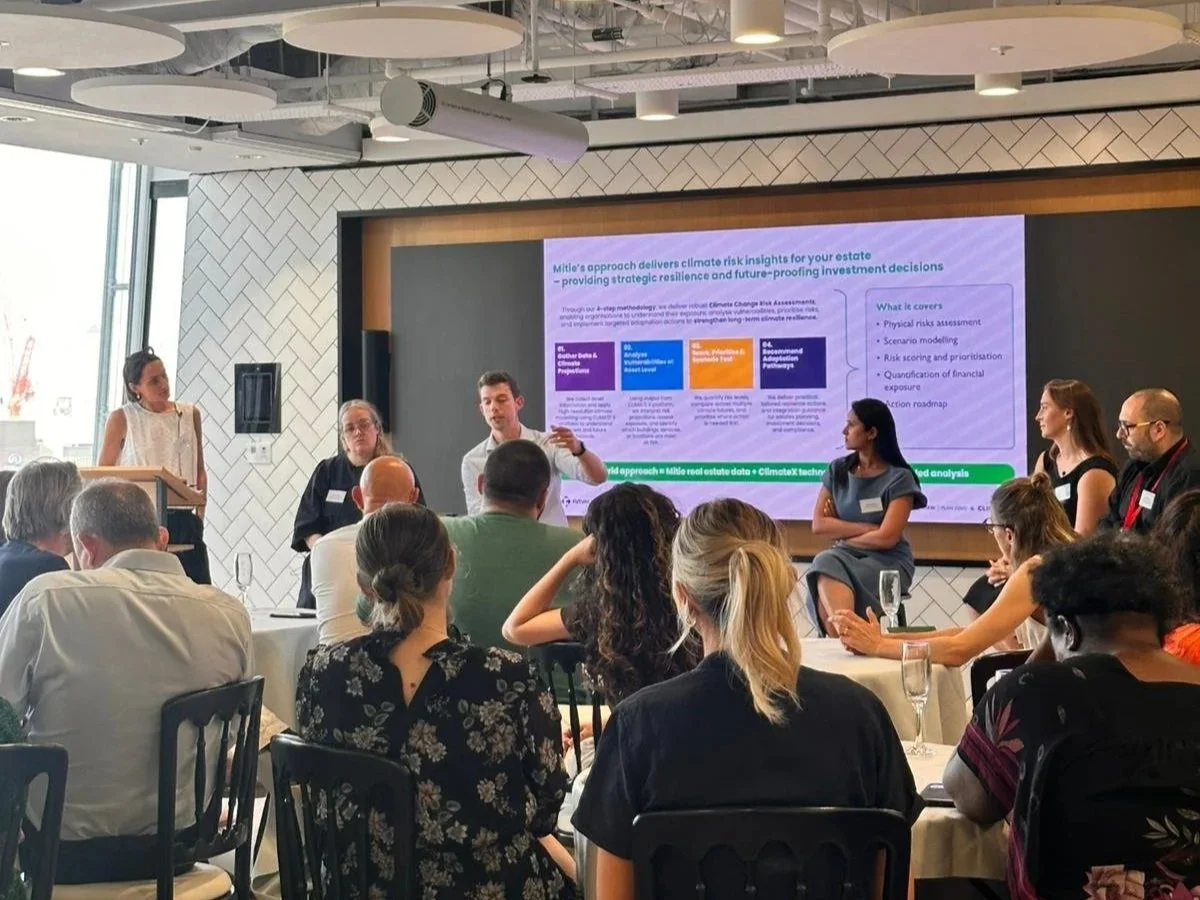
Panellists at Future Food Movement's London Climate Action Week Leaders' Briefing, hosted in partnership with Mitie and Climate X: Kate Cawley (Future Food Movement), Helen Ireland (Future Food Movement), Will Clare (Future Food Movement), Heena Minocha (Mitie), David Dowson (Mitie) and Grace Thomson (Climate X).
Food had a bigger presence at London Climate Action Week this year than ever before. But the most interesting shift was not just that food had its own dedicated day. It was that food showed up everywhere else too.
Across the week, Future Food Movement was in the room for a wide range of conversations: from Food Day at the Science Museum, to Funeral for the Food System, Kids Food & Drink Collective, Pineapple Partner Day, Business Environment Network and our own Leaders’ Briefing with Mitie and Climate X at The Shard.
The events were very different in tone. Some were focused on finance and infrastructure. Some asked bigger cultural questions about what needs to change in the food system. Others focused on children’s health, food environments, regenerative agriculture and the practical realities of climate risk.
But across all of them, one message kept resurfacing: food system transformation is no longer being discussed as a sustainability issue alone. It is becoming a business resilience issue, a health issue, a finance issue and an infrastructure issue.
Here are the themes that stood out for us.
1. Resilience is now the organising principle
At Jeremy Coller Foundation Food Day at the Science Museum, the conversation centred on food system resilience, risk and transformation. Speakers made the case that food is one of the most powerful entry points into climate action because it is both personal and universal. One of the reflections that stayed with us was the idea that we can become so attached to our own theories of change that we lose sight of the people we are trying to serve.
That point came through again and again during the week. Resilience was not being framed as a distant climate concept. It was being discussed in relation to supply chains, affordability, infrastructure, health and the everyday decisions food businesses need to make now.
This was also the central thread of Future Food Movement’s own London Climate Action Week Leaders’ Briefing with Mitie and Climate X. The session explored how climate risk is already affecting food and drink operations, from manufacturing sites and logistics networks to depots, estates and workforce continuity.
The key message was clear: climate risk does not start and end in the supply chain. It is moving into the buildings, systems and infrastructure that keep food businesses running every day.
That matters because many organisations still treat resilience as a future planning exercise. LCAW made it feel much more immediate. The question is no longer simply whether businesses have a climate strategy. It is whether they understand where risk actually lives across their operations, and whether they are building the capability to respond.
2. Food system change is cultural, not just technical
One of the most distinctive events the team attended was Funeral for the Food System, created by Dr Lucy Wallace and held at St James Garlickhythe. The event used the format of a funeral service to mourn the food system we have outgrown and ask what might become possible if we accepted that the current model is no longer fit for purpose.
It could easily have felt bleak. Instead, the event created space for honesty, imagination and hope. Speakers reflected on the true cost of cheap food, the way food has become increasingly weaponised, the pressure placed on farmers and the need to move beyond a system that tries to feed people while failing to properly nourish communities, nature or the planet.
The closing “Hopeful Plate” brought the conversation back to nourishment, connection and possibility, using food itself to imagine what a more resilient and thoughtful food culture could look like.
For us, this was an important counterpoint to the more technical and business-led sessions taking place elsewhere. Data, finance, infrastructure and policy all matter. But food system transition is also about culture, behaviour, language and imagination.
That is particularly relevant for food businesses. If climate and health strategies do not connect with people’s daily realities, they will struggle to land. The challenge is not only to build better systems, but to bring people with us.
3. Finance is becoming the language of action
Another strong signal from the week was the shift from ambition to implementation.
At Pineapple Partner Day, the discussion focused heavily on the built environment, finance, operational challenges and the need to turn concern into action. Themes included energy efficiency, circularity, investment, physical climate risk and the importance of collaboration over individual effort.
Business Environment Network also brought a finance and nature lens into the week, including discussion of nature capital and examples of organisations working more directly with farms to invest in nature-based solutions.
This connects with the wider LCAW briefing, which highlighted finance as one of the strongest themes running through the week. Conversations were increasingly focused on measurable outcomes, risk reduction, decision-useful information and the need to make the case for action in terms that finance, procurement and leadership teams can use.
For food businesses, this is a significant shift. Sustainability teams have spent years making the moral and environmental case for action. What LCAW showed is that the commercial case is now becoming much harder to ignore.
Whether the topic was regenerative agriculture, physical climate risk or food security, the same question kept surfacing: what does this mean for risk, cost, investment and long-term value?
That is where the conversation is moving next.
4. Health and climate are converging
The team also picked up a clear signal around health.
At Kids Food & Drink Collective, discussions focused on how retailers, brands and foodservice businesses can help create healthier food environments for children. Speakers talked about the rising importance of health for shoppers, the role supermarkets play in shaping diets, the barriers created by policy gaps and the need to make healthier choices easier and more appealing.
The children’s menu conversation was especially practical. Parents want more variety, smaller portions, less “beige” food and at least one fruit or vegetable option that goes beyond baked beans. There was also discussion of “health by stealth”, not as a way of hiding change, but as a way of improving food environments without creating unnecessary friction for families.
This linked closely to the wider LCAW theme that food and health are increasingly being treated as one agenda. The briefing created for Helen also noted that health had a stronger presence this year, with food appearing in conversations about climate, prevention, resilience and long-term public health outcomes.
For members, this is an important watchpoint. The health conversation is no longer separate from climate or resilience. Nutritious, affordable, sustainable and secure food systems are increasingly being discussed together.
That creates both pressure and opportunity for industry. Businesses that can connect these agendas credibly will be better placed than those treating them as separate workstreams.
5. Regenerative agriculture is shifting from values to value
Regenerative agriculture also came through strongly across the week, but the framing is changing.
The LCAW briefing highlighted that regen is increasingly being discussed through the lens of supply security, input cost volatility and long-term business resilience, not just environmental benefit. It also pointed to the importance of moving beyond carbon tunnel vision and measuring outcomes across soil, water, nature, animal welfare, community and carbon.
That matters because the case for regenerative agriculture is often still communicated as a sustainability story. LCAW suggested it is becoming a resilience story too.
Food businesses are under growing pressure to understand how climate, nature and supply risk intersect. Regenerative approaches will not scale through aspiration alone. They will need investment, credible measurement, long-term partnerships and a more honest conversation about how risk and cost are shared across the value chain.
For FFM members, the implication is clear: regenerative agriculture cannot sit in a silo. It needs to connect with procurement, finance, supply chain strategy and commercial decision-making.
6. The strongest conversations were practical, specific and cross-sector
One of the clearest lessons from the week was that the most useful conversations were not the broadest ones. They were the sessions that brought different parts of the system together around a specific challenge.
That was true at our Leaders’ Briefing with Mitie and Climate X, where the discussion brought together food systems, facilities management, physical climate risk and operational resilience.
It was also true at sessions focused on children’s food environments, finance and nature, built environment resilience and cultural change. The strongest discussions moved beyond “why this matters” and into “what needs to happen next”.
That feels like an important shift. The food sector does not need more abstract agreement that change is needed. It needs sharper, more practical collaboration around the specific blockers that prevent action.
How do we make the business case?
How do we share risk fairly?
How do we design food environments that support healthier choices?
How do we prepare operations for physical climate disruption?
How do we move from pilots to delivery?
These are the questions leaders now need to organise around.
What this means for FFM members
London Climate Action Week made one thing clear: the food system conversation is becoming more integrated.
Climate risk is now a boardroom issue.
Health is becoming part of the resilience agenda.
Regenerative agriculture is being tested against commercial realities.
Infrastructure and operations are moving into the climate conversation.
Finance is becoming one of the main languages of action.
For food businesses, this creates a different kind of leadership challenge. It is no longer enough to have separate strategies for climate, health, supply chain resilience and commercial performance. The organisations that move fastest will be those able to connect these agendas and build the internal capability to act across them.
That is where Future Food Movement’s work is focused: helping food industry leaders understand the changing system around them, make better decisions and move from ambition into practical action.
LCAW showed that the conversation is shifting. The challenge now is to make sure the sector shifts with it.